
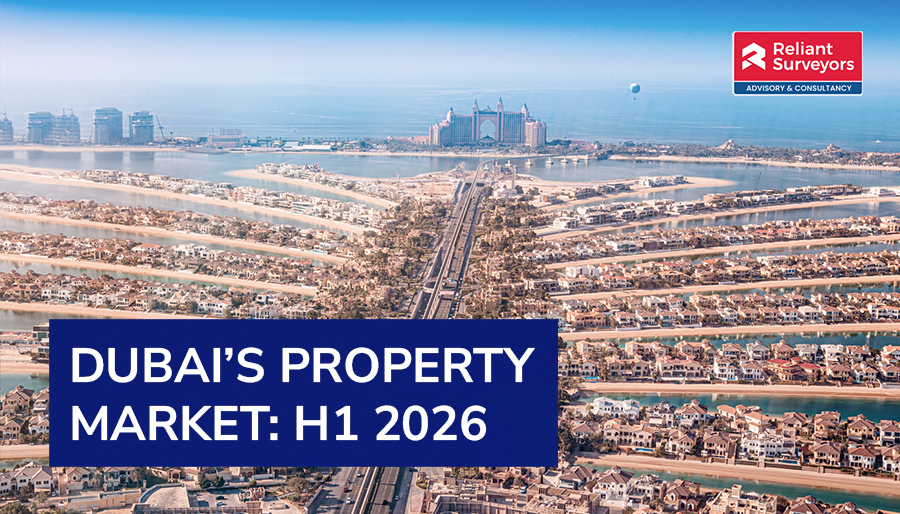
Dubai’s real estate market shifted to a more discerning stage in the first half of 2026.
Dubai’s property landscape has transitioned into a more selective phase in the first half of 2026. Influenced by geopolitical variables and their effects on the real estate sector, this shift has prompted analysts from Reliant Surveyors to evaluate market performance and predict future trends.
Active Market Dynamics
During the first half of the year, Dubai’s residential segment witnessed 81,839 transactions totaling AED 225.7 billion. This six-month timeline showcased a resilient market that showed signs of segmentation within various categories—off-plan vs. completed properties, as well as differentiation among apartments, villas, and luxury segments. Off-plan sales played a dominant role, accounting for 73.8% (60,425 transactions) of total residential sales, with a value reaching AED 168.2 billion. The secondary market added a further 21,436 transactions valued at AED 57.5 billion, indicating a robust interest in both new developments and established properties.
The increased focus on off-plan transactions underscores a sustained confidence in Dubai’s ongoing development initiatives. New master communities and emerging residential corridors have effectively attracted buyers, pointing to a vibrant real estate pipeline.
Apartments Lead the Charge
Apartments have emerged as the driving force in market liquidity, marking 68,739 transactions worth AED 133.9 billion—approximately 84% of residential sales activity. In contrast, villa transactions numbered 13,100, with a value of AED 91.3 billion. The discrepancy in numbers reflects the growing demand for larger homes in well-established neighborhoods.
A closer look at market pricing offers insights into ongoing trends. By the end of June, average apartment sales prices fell to around AED 1,790.8 per square foot, down from AED 1,852.8 at the end of the previous year. Villas remained relatively stable with average prices closing at AED 2,324.7 per square foot, slightly down from AED 2,330.7. Notably, gross rental yields for apartments stood at 6.93%, compared to 4.48% for villas, highlighting apartments’ superior income return potential.
Luxury Segment Resilience
Significantly, the luxury real estate market sustained substantial transactions during H1 2026. A total of 1,114 transactions exceeding AED 20 million accounted for about AED 40.08 billion in sales. Surprisingly, 76% of these luxury sales were off-plan developments, indicating confidence in higher-end properties. Noteworthy areas included The Oasis, which led in transaction count with 199 sales, while Dubai Hills Estate stood out for generating the highest luxury transaction value at around AED 6.02 billion.
In addition, localities like Jumeirah Village Circle experienced the highest residential transaction volume with 5,138 sales, displaying a diverse audience gravitating towards different types of properties.
Market Outlook and Conclusion
The insights from H1 2026 reveal a transition toward a more discerning market focused on pricing discipline, quality of projects, and long-term value—traits increasingly determining buyers’ decisions. While the market retains a sense of activity, individual assets, community development, and overall proposition will increasingly influence performance.
In summary, this evolving landscape highlights that while capital remains accessible, its deployment is occurring with a greater level of selectivity. This trend points to a maturation in Dubai’s real estate market, making it imperative for stakeholders to adopt a nuanced approach in understanding buyer preferences and market dynamics.