
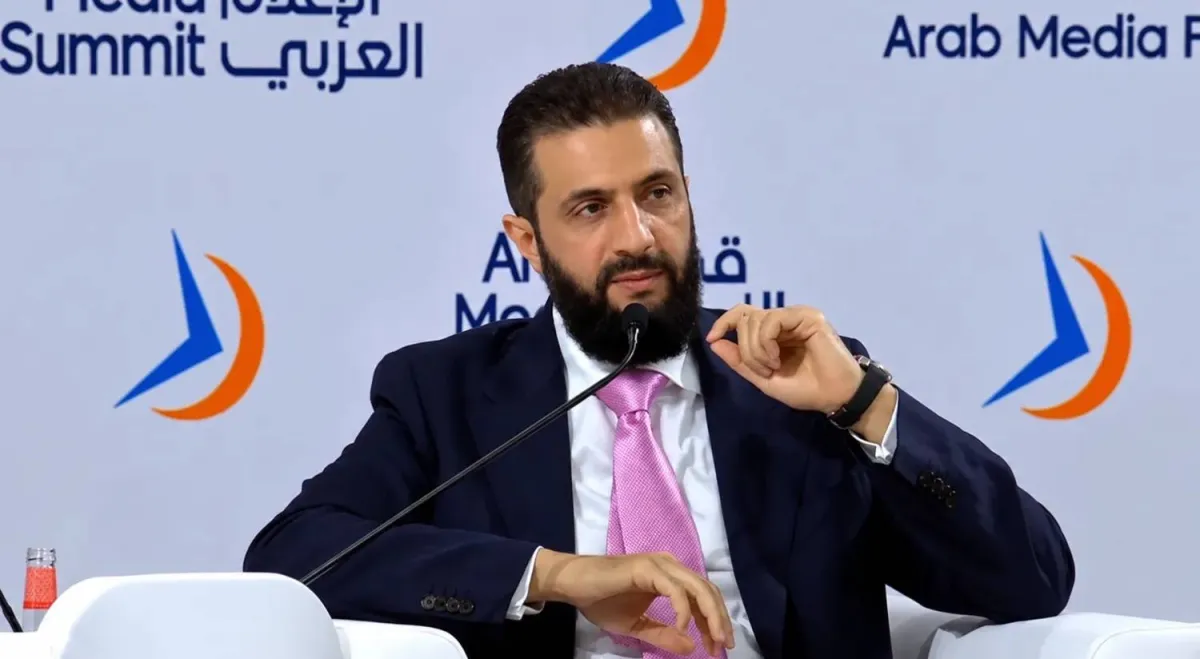
Economic Shift Requires Bold Decision-Making
Syria is at a pivotal moment in its economic trajectory, with significant challenges and opportunities ahead. President Ahmad al-Sharaa recently emphasized the need for transformative changes during his address at the Arab Media Summit in Dubai. He conveyed a vision of Syria evolving from a regional concern into a potential asset for global trade and energy security, aiming to create a vibrant economy that connects East and West.
Syria’s Economic Recovery Plan
Al-Sharaa revealed that Syria’s economy is projected to rise significantly, potentially hitting $50 billion this year, a marked improvement from about $20 billion in 2024. He stressed that achieving this economic revival would require “shock” decisions, hinting at controversial initiatives like increasing fuel prices, which have sparked unrest in various regions. His administration is committed to moving beyond mere promises and complaints; instead, they focus on delivering tangible results for the Syrian populace.
The government aims to transition from a heavily bureaucratic and corrupt economic model toward a more dynamic environment that encourages private investment. However, al-Sharaa warned that a sudden overhaul could lead to significant upheaval. By studying other nations that have undergone similar transformations, his team understands that a balanced approach—incorporating gradual changes along with abrupt policy shifts—will be vital for successfully navigating this transition.
Regional Risks and Stability Challenges
Despite the economic aspirations, Syria faces considerable regional risks that must be managed effectively. Al-Sharaa acknowledged the “heavy legacy” of 14 years of continuous conflict and 60 years of systemic destruction. He believes that simply ending the internal conflict isn’t enough for sustainable peace; there must also be a broader commitment to regional stability. The potential for conflicts to spill over remains a pressing concern, necessitating proactive diplomatic efforts with neighboring Arab nations to reduce the dangers of future wars.
As part of Syria’s rejuvenation strategy, rebuilding state institutions and infrastructure is key to restoring domestic stability. Al-Sharaa expressed a desire for Syria to shift from being a hub for illicit activities to a center of stability and prosperity. This shift is intended to enhance Syria’s role in facilitating regional trade and energy security, supporting its strategic geographical positioning between East and West.
Foreign Policy Direction
In regard to foreign relations, al-Sharaa made it clear that Syria aims for partnerships built on “credibility and trust,” highlighting its desire for independent decision-making. He asserted that Syria need not mimic other nations, emphasizing the country’s extensive cultural heritage, expertise, and human resources as assets in crafting its foreign policy. While acknowledging the importance of collaboration, he underscored the need for Syria to leapfrog developmental stages rather than starting from scratch, aiming instead to draw lessons from countries that have already progressed.
A significant roadblock to Syria’s recovery has been decades of harsh international sanctions. Al-Sharaa lamented the isolation that has hindered generations of Syrians from engaging in normal financial practices. However, recent dialogues involving leaders like Saudi Crown Prince Mohammed bin Salman and Turkish President Erdoğan concerning the lifting of sanctions may mark a turning point in Syria’s fortunes.
He affirmed that with sanctions now being eased, the nation has the potential to “be born again,” provided it adopts the right policies and strategies. Al-Sharaa’s vision for Syria is ambitious, aiming not just for a revival but for a robust economy capable of contributing to regional and global stability, setting the stage for a brighter future.