
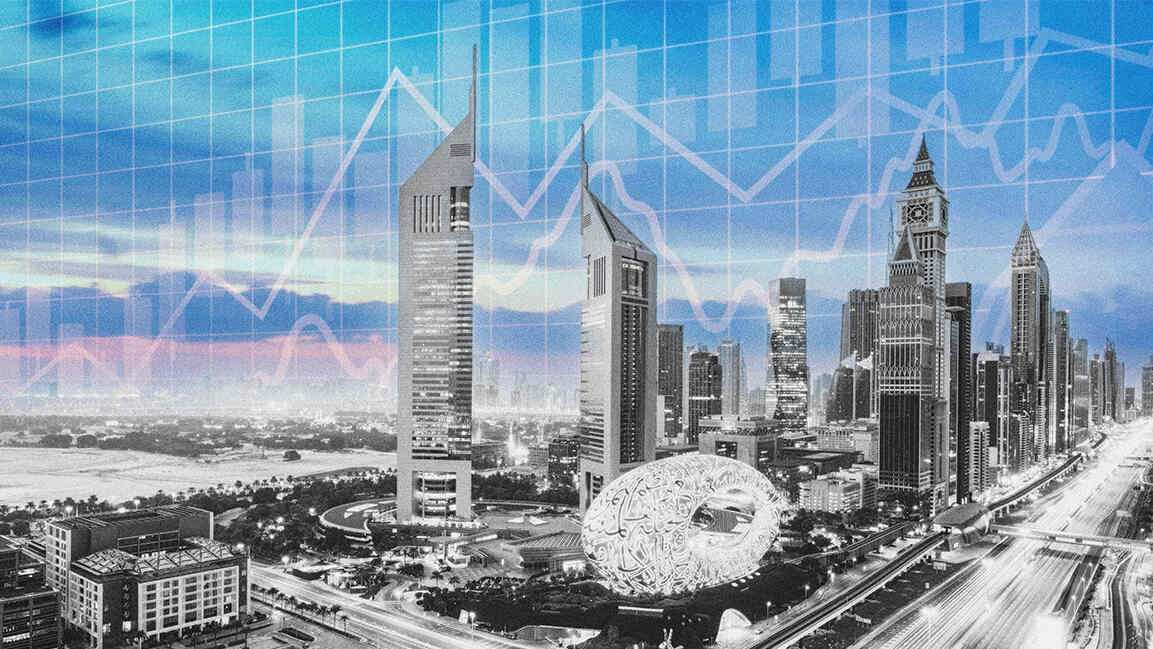
Dubai’s H1 2026 GDP Reaches $128.8 Billion
The economy of Dubai has experienced noticeable fluctuations, as revealed by recent data for the first half of 2026. The reported real gross domestic product (GDP) stood at approximately $128.8 billion, reflecting a decline of 2.3% compared to $131.8 billion during the same timeframe in 2025. This information was disclosed by the Dubai Data and Statistics Establishment as part of the digital initiatives in the region.
Current Price Growth and Sector Performance
In terms of nominal GDP, the figures reached around $137.4 billion, marking a modest year-on-year increase of just 0.2%. Sector performance has varied considerably, indicating a complex response to shifts in the global economy. Noteworthy growth was observed in financial services, healthcare, information and communication, and construction sectors. Specifically, financial and insurance activities saw a robust real growth of 8.8%, pushing the sector’s value added to approximately $18 billion from last year’s $16.9 billion. This sector now constitutes about 14% of the real GDP, an increase from 12.5% recorded in the first half of 2025.
Healthcare and social work activities greatly outperformed expectations, experiencing a real growth of 14.3%, boosting their value added to around $1.7 billion, up from $1.5 billion in the previous year. The electricity, gas, and waste management sector also reported a commendable growth rate of 5.4%, providing about $2.8 billion in real value added. Meanwhile, the information and communication sectors displayed a modest growth of 2.7%, with a value added of approximately $6.7 billion. Construction expanded by 2.4%, contributing nearly $9 billion in real value added.
Economic Drivers and Investment Landscape
Helal Saeed Almarri, the director general of the Dubai Department of Economy and Tourism, emphasized that growth in these strategic sectors underlines the resilience of the economy and reinforces the Dubai Economic Agenda, D33. This agenda emphasizes attracting investments, fostering innovation, and nurturing talent—essential elements for enhancing competitiveness in the region. Additionally, Hamad Obaid Al Mansoori, director general of Digital Dubai, pointed to the importance of economic diversification, digital transformation, and artificial intelligence as pivotal components driving efficiency and competitiveness.
Investment interest remains robust, particularly in sectors that are aligned with future growth, according to Hadi Badri, chief executive of the Dubai Economic Development Corporation. Badri noted that continuous improvements to the business landscape, infrastructure, and talent availability would further bolster investment opportunities in Dubai’s diverse economy.
Trade and Sector-Specific Insights
Wholesale and retail trade remains the dominant economic activity in Dubai, accounting for 20.5% of the real GDP in the first half of 2026. This was followed closely by financial services at 14%, real estate at 11.8%, and transportation and storage at 10.7%. Despite trade activity experiencing a decline of 6% in real terms, it recorded a 2% growth when viewed at current prices, largely attributed to the pressures of rising inflation. Interestingly, Dubai’s foreign trade witnessed a 4% increase year on year during the same period.
In addition to these statistics, the transportation and storage sector presented a value added of around $13.7 billion, showing a reduction of 7.4%. Even though real estate saw a current price growth of 5.4%, equating to a value added of approximately $17.7 billion, it faced a contraction of 2.5% in real terms. The manufacturing sector, on the other hand, reported a value added of around $6.6 billion but saw a real decline of 0.9%, amounting to about $6.4 billion.
In summary, while the Dubai economy has faced some challenges in the first half of 2026, certain sectors demonstrated resilience and growth. Through strategic investments and initiatives, Dubai is positioned to navigate these complexities and continue its trajectory toward sustainable economic development.