
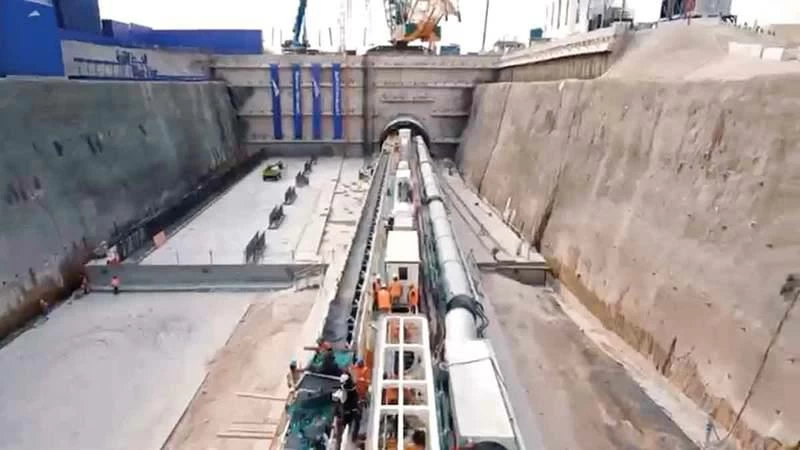
Dubai Metro Blue Line reaches significant construction milestones
Dubai is making significant strides in its ambitious metro expansion with the latest developments in the Blue Line project. The Roads and Transport Authority (RTA) has not only completed over 2,800 meters of tunneling work but has also reached a milestone with the construction of foundations for the iconic stations. This transformation reflects Dubai’s commitment to enhancing its urban infrastructure and facilitating efficient public transportation.
Progress in Tunnel Excavation and Construction
The RTA has announced that more than 2,000 meters of tunnels have been excavated, aided by the advanced “Al Waqisha 1” drilling machine, which recently arrived at the Dragon Souq Station—the first tunnel station in this massive project. Additionally, over 800 meters of overhead bridges have been completed, contributing to the overall progress of the Dubai Metro Blue Line. Remarkably, the deep foundations for the renowned “Emaar Properties” station have been completed in full, while work on the Dubai Creek crossing stands at 30% completion.
These developments are in line with the project’s timeline, which aims for a scheduled opening in September 2029. The RTA’s updates indicate that the construction of the Blue Line is operating smoothly, progressing steadily through multiple phases of underground and above-ground work, effectively combining tunnels, bridges, and stations.
Innovative Technology in Tunneling
The project boasts the deployment of cutting-edge tunneling techniques and an integrated manufacturing system, ensuring the timely delivery of one of Dubai’s most ambitious transport projects. The “Al Waqisha” machine, equipped with advanced digital guidance and monitoring tools, has achieved substantial progress, digging between 13 and 17 meters per day on average—with capabilities of reaching up to 30 meters daily under optimal conditions. This technological advancement illustrates the evolution of tunneling methods since the inception of the Dubai Metro.
The achievement of completing over 2,000 meters of tunnels marks a significant milestone in the construction journey. Starting from the International City Station and moving towards subsequent stations, the progress made emphasizes Dubai’s dedication to creating a state-of-the-art metro system designed to accommodate a growing population.
Station Development and Future Prospects
The construction of the iconic “Emaar Properties” station is currently underway, with the RTA announcing that its deep foundations are complete. This station is poised to be the tallest metro station globally, towering at 74 meters, with a design that encompasses an area of 11,000 square meters and a projected capacity of 160,000 passengers daily. Its construction is anticipated to establish it as one of the engineering marvels associated with the metro project.
Significant advancements have also been noted in the overhead bridge construction, with more than 800 meters completed. In parallel, the Dubai Creek crossing, set to be the longest metro bridge crossing the creek at 1.3 kilometers, continues to progress, currently at 30% completion. This landmark crossing is expected to be finished by 2027.
To ensure efficient progress, the RTA has established facilities equipped to handle a considerable inventory of necessary materials, including a tunnel ring factory that has successfully produced over 1,700 concrete rings, enough to cover about three kilometers of tunneling work. With civil and construction activities advancing, the RTA is preparing for the arrival of additional tunneling machines at future project sites.
In conclusion, the Dubai Metro Blue Line project represents a monumental investment of AED 20.5 billion. With a total length of 30 kilometers, consisting of 14 stations, it promises to serve nine areas crucial for the emirate’s urban planning objectives for 2040. As it moves forward, the completion rate is projected to reach 30% by the end of 2026, reaffirming Dubai’s ambitions for an efficient and interconnected transport network.