
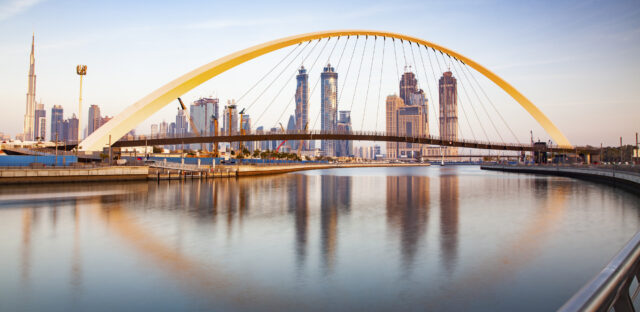
Dubai Charts Waterways for Its Digital Replica
Dubai has launched an innovative mobile mapping pilot survey of its waterways, a key initiative that enhances the city’s geospatial capabilities and supports its Digital Twin project. This effort showcases the city’s commitment to modernizing its infrastructure while fostering sustainable growth.
Advanced Mobile Mapping Technology
The mapping endeavor employed the Leica TRK system, which was mounted on a specially designed vessel that navigated the Dubai Water Canal in Al Jaddaf. Through this high-tech methodology, the project successfully captured detailed datasets and generated precise 3D models in collaboration with specialized partners. The meticulous data collection aims to furnish stakeholders with accurate and frequently updated spatial information, which is critical for numerous sectors, including urban planning and asset management.
Strengthening Digital Infrastructure
According to Maitha Alnuaimi, director of the GIS Centre Department at Dubai Municipality, this initiative is a vital component of the Emirate’s ongoing efforts to enhance its digital infrastructure. By constructing an integrated geospatial database, the project not only supports the Digital Twin initiative but also empowers government entities to make informed, timely decisions based on reliable information. This initiative plays a crucial role in improving the efficiency and sustainability of urban management, aligning with Dubai’s vision of a smart and forward-looking city.
The Role of Digital Twin Technology
The mobile mapping project is instrumental in advancing Dubai’s ambitious Digital City initiative. Utilizing artificial intelligence, Internet of Things (IoT) sensors, and Geographic Information Systems, this project aims to create a real-time 3D virtual representation of the city. This digital model encompasses a range of features, from waterways and skyscrapers to subsurface utilities, allowing for comprehensive city planning and management.
Recently, Dubai Police leveraged Digital Twin technology to reevaluate a bridge fall incident involving a delivery driver. Initial reports indicated a possible suicide, but through detailed 3D modeling and virtual reality tools, investigators reconstructed the accident scene. It was revealed that the rider’s motorcycle had been struck from behind, transforming the case from a suspected suicide into a hit-and-run investigation, which has since escalated into a criminal case.
In yet another instance of the effectiveness of Digital Twin applications, the technology was utilized to investigate a structural collapse at a basement parking facility. What seemed to be an inexplicable failure was traced back to recurrent water leakage that gradually compromised the integrity of concrete supports. Such findings underline the value of integrating advanced technology into investigative processes, enhancing not just safety but also operational efficiency.
In summary, Dubai’s mobile mapping pilot survey is a significant advancement in the city’s journey toward becoming a global leader in digital infrastructure and smart city solutions. By harnessing innovative technologies, Dubai is setting a benchmark for urban management and urban planning, ensuring a sustainable future for its residents while fostering an environment conducive to cutting-edge research and development.