
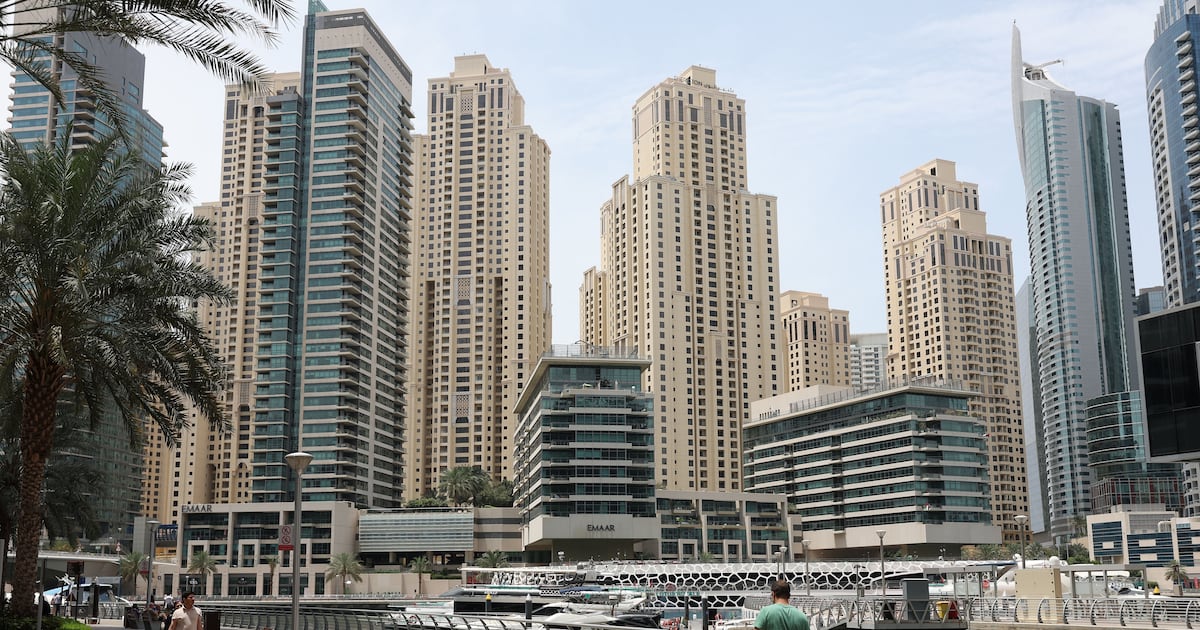
UAE Real Estate Transitions to a ‘Buyer’s Market’ for the First Time in Years
Dubai’s residential property market is experiencing its most advantageous conditions for buyers in several years. Market trends indicate a stabilization in villa prices, a decrease in transaction volumes, and an increased willingness among sellers to negotiate, according to industry professionals and updated market reports.
### Current Market Dynamics
In the first quarter, growth in sales prices for Dubai’s residential sector slowed to about 9% year-on-year. This decrease marks a significant drop from the double-digit increases seen during the post-pandemic surge. Transaction volumes also fell by approximately 20% in March, influenced by regional conflicts. Notably, new data from property platform YallaValue and CBRE’s UAE Real Estate Market Review provide further insights into these shifting dynamics. Despite the moderation in price growth, residential properties have not lost value, backed by a robust UAE banking sector and a reaffirmed AA/A-1+ credit rating from S&P Global Ratings.
This current market scenario represents a unique opportunity for long-term buyers, particularly those inclined to be patient. Matthew Bate, the CEO of BlackBrick Property, observes that properties are trading at fair market values and, in some instances, slightly below. He emphasizes that the buyer profile has evolved, with many now being domestic buyers who hold both financial and emotional stakes in Dubai’s real estate landscape.
### Long-term Outlook
Bate’s insights suggest that the present environment fosters a sustainable investment atmosphere rather than the urgency that characterized the previous years. Buyers can now engage in meaningful negotiations, positioning themselves to acquire quality assets ahead of potential market rebounds. He advises those considering a long-term hold—specifically for five years or more—to view this as a favorable time to invest.
Financial experts like Steve Cronin support this perspective, highlighting the importance of a long-term horizon in real estate investments, ideally spanning five to ten years. He warns against overextending financially, cautioning potential buyers about managing mortgage responsibilities. While the current market may seem advantageous for buyers, it also remains a renter’s market, with rental yields not expected to match previous highs.
### The Case for Patience
Current rental yields in Dubai, although moderating, still fare well compared to global standards. According to Daniel McCulloch of CBRE Mena, the buy-to-let sector benefits from relatively high yields and the absence of both income and capital gains tax in the UAE, presenting a compelling value proposition for investors. For those who adopt a long-term approach, the emphasis should be on remaining in the market for extended periods rather than trying to time the market for quick gains.
Broader market analysis bolsters this outlook. Recent reports indicate that, while growth in sales prices for Dubai’s residential sector has slowed, actual prices have not declined. Meanwhile, Abu Dhabi’s residential market is witnessing record transaction values. Matthew Green, head of research at CBRE MENA, attributes these trends to factors such as structural undersupply and the UAE’s strong institutional frameworks, which together strengthen the market’s foundation.
### A Maturing Market
However, the Dubai real estate market is facing challenges not previously encountered. A recent analysis by property consultancy Cavendish Maxwell suggests that geopolitical risks are now fundamental considerations for Gulf investors. Events such as regional tensions and fluctuations in hydrocarbon prices can significantly impact construction costs, rents, and property values. Buyers entering the market must consider these uncertainties in their long-term investment strategies.
On the developer side, Ahmad Sultan Al Shammari of Palladium Prime Real Estate Development notes that the market is evolving. This transition is not necessarily a slowdown, but rather a shift toward more informed and disciplined decision-making. He points out that demand is becoming selective, favoring well-located and well-designed projects by reputable developers, which continue to thrive across various price segments.
In summary, while patience is essential for potential buyers, a favorable environment is emerging for those willing to navigate the complexities of the current market. The focus on high-quality assets from credible developers and strategic long-term planning positions buyers for success amidst a dynamic real estate landscape in Dubai.