
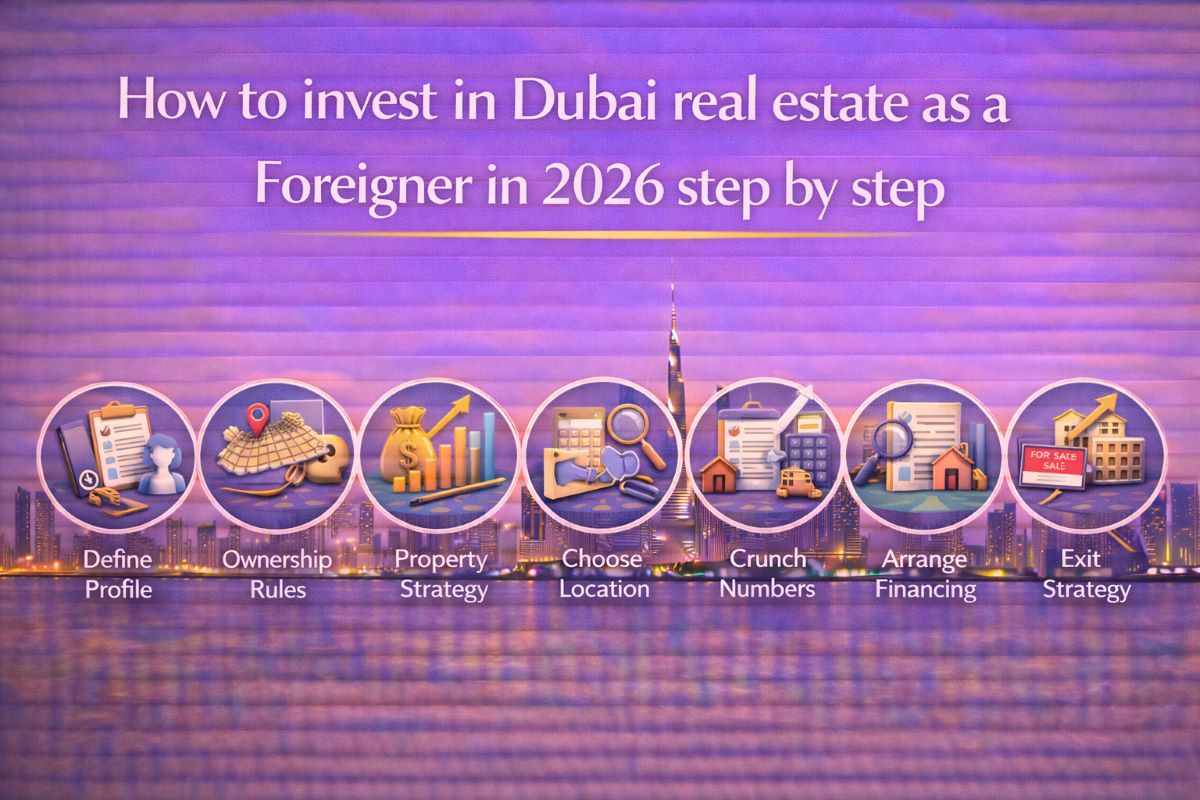
How to invest in Dubai real estate as a foreigner in 2026 step by step?
Dubai remains one of the most accessible and attractive real estate markets for foreign investors in 2026. With full ownership rights in designated areas, a tax-efficient environment, strong rental demand, and a transparent legal framework, investing in Dubai property as a foreigner has become a structured and predictable process rather than a complex challenge.
This step-by-step guide is designed for international buyers who want a clear, practical roadmap. It explains how to invest in Dubai real estate as a foreigner in 2026, from defining your strategy to completing the purchase, managing the property, and optimizing long-term returns. The focus is on real decision-making, realistic expectations, and search intent aligned with action.
Define your investment goal and strategy before buying property in Dubai
The first and most important step when investing in Dubai real estate as a foreigner is defining your investment objective. Dubai offers multiple strategies, and the right property depends entirely on what you want to achieve financially and personally.
Some investors focus on rental income, aiming for stable monthly cash flow and passive income. Others prioritize capital appreciation, targeting off-plan projects or emerging areas where value growth is expected over time. A third group combines lifestyle and investment, buying property for future relocation while generating rental income in the meantime.
Before moving forward, clarify:
- income-focused vs growth-focused strategy
- short-term vs long-term holding period
- risk tolerance and market exposure
- active vs passive management preference
A clear strategy prevents emotional decisions and aligns every next step with measurable goals.
Understand foreign ownership rules in Dubai real estate
Foreigners can legally invest in Dubai real estate through full freehold ownership in designated areas. Freehold ownership means you own the property outright, including the right to sell, lease, inherit, or hold it long term without restrictions.
Foreign investors can buy property as individuals or through a company structure, depending on tax planning, asset protection, or portfolio strategy. Many buyers choose individual ownership for simplicity, while others prefer corporate ownership for larger portfolios.
Key ownership considerations include:
- freehold vs leasehold differences
- individual vs company ownership
- joint ownership and inheritance planning
- title deed as legal proof of ownership
Understanding ownership rights early ensures compliance and long-term security.
Set your budget and understand the full cost of investing in Dubai property
When investing in Dubai real estate as a foreigner, it is essential to calculate more than just the purchase price. A realistic budget includes both one-time acquisition costs and ongoing ownership expenses.
One-time costs typically include registration fees, administrative charges, valuation fees, and agent commissions. Ongoing costs may involve service charges, maintenance, insurance, and property management, especially for rental properties.
A strong budget plan considers:
- total capital required, not just price
- net ROI after all costs
- cash buffer for unexpected expenses
- furnishing costs for rental optimization
Accurate budgeting protects returns and prevents underestimating the true investment commitment.
Choose the right property type for your Dubai real estate investment
Dubai offers a wide range of property types, and selecting the right one directly impacts ROI. Apartments are the most common investment choice due to liquidity and strong rental demand, while villas and townhouses appeal to family-oriented tenants and end-users.
Foreign investors can choose between:
- residential apartments for long-term or short-term rental
- villas and townhouses for family tenants
- off-plan properties for capital growth
- ready properties for immediate income
- holiday homes for higher short-term yields
Matching the property type to your strategy is critical for performance and exit flexibility.
Pick the right location when investing in Dubai real estate as a foreigner
Location is one of the strongest drivers of rental demand, appreciation, and resale liquidity. In Dubai, infrastructure, connectivity, and lifestyle amenities play a major role in determining long-term value.
Prime areas offer stability and consistent demand, while emerging districts may offer higher growth potential at lower entry prices. Tourist-focused areas suit short-term rentals, while residential communities favor long-term leasing.
Key location factors include:
- proximity to business hubs and transport
- tenant profile and rental demand
- community maturity and future development
- resale liquidity and buyer demand
A strong location strategy reduces vacancy risk and improves ROI.
Decide between off-plan and ready property investment in Dubai
Foreign investors in Dubai can choose between off-plan properties, purchased before completion, and ready properties, which are immediately available. Each option serves a different investment purpose.
Off-plan properties often offer lower entry prices and flexible payment plans, making them attractive for capital appreciation. Ready properties provide immediate rental income and greater certainty, appealing to income-focused investors.
The choice depends on:
- time horizon and liquidity needs
- tolerance for construction timelines
- income vs growth priorities
Understanding this distinction avoids mismatched expectations.
Conduct professional-level due diligence before buying
Due diligence is essential when investing in Dubai real estate as a foreigner. This step protects capital and ensures the property aligns with projected returns.
Buyers should evaluate developer reputation, building quality, service charges, rental demand, and legal documentation. Overlooking due diligence is one of the most common mistakes among first-time foreign investors.
Effective due diligence includes:
- developer track record analysis
- realistic rental price assessment
- service charge impact on net yield
- documentation and title verification
Careful analysis separates strong investments from risky ones.
Understand the legal process of buying property in Dubai
The Dubai property purchase process is structured and transparent. Buyers typically sign a reservation agreement, followed by a Sales and Purchase Agreement or Memorandum of Understanding, depending on whether the property is off-plan or resale.
The transaction is registered with the relevant authority, and ownership is finalized upon payment completion and title deed issuance. Buyers can purchase remotely using Power of Attorney if needed.
Understanding each legal step ensures a smooth transaction and prevents delays.
Decide between cash purchase and mortgage financing
Foreign investors can buy Dubai property with cash or through mortgage financing. Cash buyers benefit from faster transactions and stronger negotiation power, while financed buyers preserve liquidity.
Mortgage availability for non-residents depends on income profile, down payment size, and bank requirements. Financing affects ROI, risk exposure, and exit flexibility.
Choosing the right payment method depends on:
- capital availability
- risk tolerance
- interest rate environment
- long-term portfolio goals
Both approaches can be effective when aligned with strategy.
Complete the purchase and register your Dubai property
Once final payments are made, the property transfer is completed and registered. The buyer receives the title deed, which confirms legal ownership. For ready properties, a handover inspection ensures quality and condition.
This step marks the transition from investor to owner and opens the door to rental or resale strategies.
Plan your rental strategy and property management
After purchase, investors must decide how to generate income. Long-term leasing offers stability, while short-term rentals can deliver higher returns with active management.
Many foreign investors choose professional property management to ensure hands-off operation. A well-managed property performs better, retains tenants longer, and preserves asset value.
Rental planning should include:
- pricing strategy
- furnishing decisions
- tenant management
- maintenance planning
Strong management directly improves ROI.
Optimize ROI and build a long-term Dubai real estate portfolio
Long-term success comes from optimization, not just acquisition. Investors can improve returns through upgrades, rent adjustments, refinancing, or reinvesting into additional properties.
Diversification across areas and property types reduces risk and stabilizes income. Exit strategies should be planned in advance, not improvised.
Residency options and practical considerations for foreign investors
Property ownership in Dubai can support long-term residency options under certain conditions. While residency should not be the sole reason to invest, it adds lifestyle and mobility value.
Banking, insurance, and compliance considerations should also be addressed early for smooth ownership.
Common mistakes foreign investors should avoid in 2026
Foreign buyers often make avoidable mistakes such as buying based on hype, ignoring service charges, or choosing unsuitable rental strategies. Education and planning prevent costly errors.
Summary
Investing in Dubai real estate as a foreigner in 2026 is a structured, accessible, and potentially highly rewarding process when approached step by step. Success depends on clear strategy, smart location selection, proper due diligence, and realistic financial planning. With the right execution, Dubai real estate can deliver strong income, growth, and long-term portfolio value.