
Dubai real estate vs global markets in 2026: where does ROI perform better?
As we move toward 2026, real estate investors are increasingly focused on one core question: where does return on investment perform better—Dubai real estate or global markets? Rising interest rates, geopolitical uncertainty, inflation, and changing migration patterns are reshaping property strategies worldwide. Investors are no longer just looking for safe assets; they want strong ROI, tax efficiency, and long-term resilience.
This in-depth analysis compares Dubai real estate with major global property markets through the lens of ROI performance in 2026. It addresses rental yields, capital appreciation, entry costs, taxation, risks, and investor suitability, helping buyers and investors align strategy with market reality.
Understanding ROI in real estate investments
Return on investment in real estate is not a single number—it is a combination of rental income, capital appreciation, and cost efficiency. In practical terms, ROI measures how effectively an asset generates profit relative to the capital invested.
There are several ways investors evaluate ROI. Rental yield focuses on annual income, while capital appreciation reflects price growth over time. Cash-on-cash return measures income relative to actual cash invested, while total return combines income and appreciation. In 2026, investors increasingly look at risk-adjusted ROI, not just headline numbers.
Understanding ROI properly is essential before comparing Dubai real estate to global markets. A market with lower yields but higher taxes may underperform a market with higher yields and zero income tax, even if purchase prices appear similar at first glance.
Global real estate markets outlook in 2026
Many global real estate markets are entering a period of maturity by 2026. Cities such as London, Paris, New York, and Singapore are characterized by high entry prices, slower growth, and tighter regulations. While these markets offer stability, ROI potential is often constrained by taxation, saturation, and limited price upside.
Rental yields in major global cities have been compressed over time due to rising property values and regulatory pressure. Rent controls, tenant protection laws, and higher ownership taxes further reduce net returns. As a result, many investors rely more on long-term capital preservation than income generation.
For investors prioritizing growth and cash flow, these mature markets increasingly struggle to compete with emerging, high-growth destinations where demographic expansion and economic diversification are still actively driving demand.
Dubai real estate market outlook in 2026
Dubai enters 2026 as a growth-oriented real estate market rather than a saturated one. Strong population growth, continued inflow of expatriates, and expanding business activity support sustained demand for both rental and owner-occupied properties.
Government initiatives focused on economic diversification, infrastructure investment, and long-term residency have strengthened investor confidence. Dubai’s real estate market benefits from continuous development of new communities, transport networks, and lifestyle hubs, which fuels both rental demand and capital appreciation.
Unlike many global markets, Dubai still offers growth-stage characteristics combined with strong regulation, making it attractive for investors seeking both income and appreciation.
Rental yields: Dubai real estate vs global markets
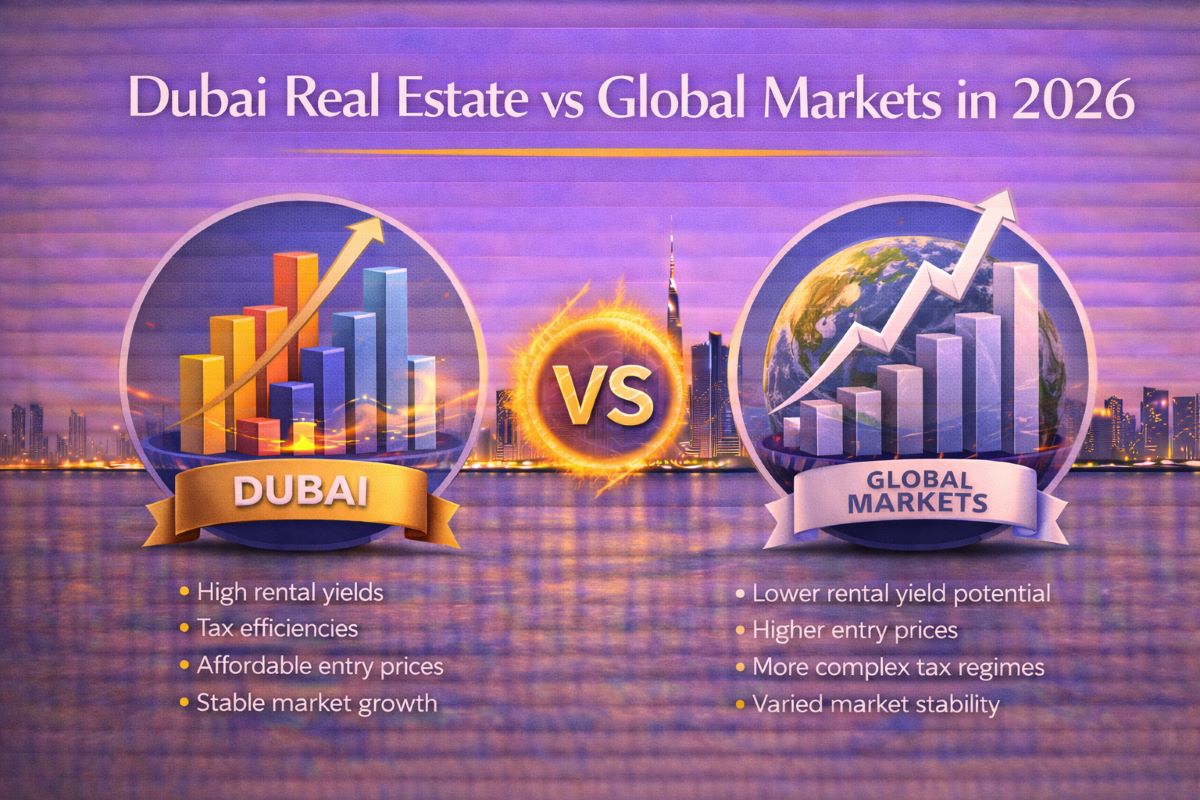
Rental yield is one of the clearest areas where Dubai real estate outperforms most global markets in 2026. Average rental yields in Dubai typically remain higher than in major European and North American cities.
Several factors contribute to this advantage:
- strong tenant demand driven by expats and professionals
- flexible rental regulations
- limited income taxation
- high occupancy rates in well-located areas
In contrast, global cities often experience lower net yields due to high purchase prices and rental restrictions. For income-focused investors, Dubai real estate provides a clearer path to consistent cash flow.
Capital appreciation potential comparison
Capital appreciation in Dubai real estate is closely tied to development cycles and infrastructure expansion. New communities, off-plan projects, and master-planned areas often experience significant value growth over time.
In mature global markets, appreciation tends to be slower and more incremental. Price growth is constrained by limited affordability and regulatory intervention. While stability remains high, upside potential is often capped.
Dubai’s ability to expand horizontally and vertically allows for value creation, especially when investments are made early in development phases or emerging districts.
Entry prices and affordability impact on ROI
One of the strongest advantages of Dubai real estate in 2026 is relative affordability. Entry prices per square meter remain significantly lower than in most global capitals, despite offering modern infrastructure and premium amenities.
Lower entry prices mean:
- higher yield potential
- easier portfolio diversification
- lower capital concentration risk
In global markets, high entry costs reduce flexibility and make scaling a portfolio more difficult. Dubai’s affordability directly enhances ROI by lowering the capital required to generate comparable or superior returns.
Tax efficiency and ROI performance
Taxation plays a critical role in determining real ROI. Dubai’s tax environment remains one of the most investor-friendly globally, with no personal income tax and no capital gains tax on property sales.
In many global markets, rental income is heavily taxed, and capital gains taxes significantly reduce net returns. Over long holding periods, this tax drag can erode a substantial portion of investment performance.
Dubai’s tax efficiency allows investors to retain more of their income and appreciation, improving long-term ROI outcomes.
Operating costs and net returns
Operating costs affect net ROI more than many investors initially realize. Dubai real estate typically involves transparent service charges and predictable maintenance costs.
While service charges exist, the absence of property tax and income tax often results in higher net returns compared to global markets where taxes, compliance costs, and regulatory fees accumulate over time.
For investors focused on net performance rather than gross figures, Dubai continues to show a competitive advantage.
Risk profile: Dubai vs global real estate markets
Every market carries risk, but the nature of risk differs. Dubai real estate risks are typically linked to market cycles, supply levels, and project selection. These risks are mitigated through regulation, escrow systems, and government oversight.
Global markets face different risks, including political uncertainty, regulatory changes, rent controls, and demographic stagnation. While perceived as stable, these risks can significantly impact ROI.
When assessed on a risk-adjusted ROI basis, Dubai often compares favorably due to higher reward potential relative to manageable risk.
Liquidity and exit strategy comparison
Liquidity is a critical factor in ROI realization. Dubai’s real estate market offers strong transaction volume and diverse buyer demand, supporting efficient resale in prime and mid-market segments.
Global markets may offer stability but often involve longer selling periods and higher transaction costs. Dubai’s investor-friendly processes and international buyer base enhance exit flexibility.
Effective exit strategies contribute directly to realized ROI, not just projected returns.
Financing and leverage impact on ROI
Financing conditions influence ROI differently across markets. In Dubai, mortgage availability for foreign investors exists, though many buyers choose cash purchases to maximize net returns.
In global markets, higher interest rates and stricter lending criteria can reduce leveraged ROI significantly. Dubai’s relatively flexible financing environment allows investors to choose strategies aligned with risk tolerance.
Leverage, when used carefully, can amplify ROI in both markets, but tax and interest rate differences often favor Dubai.
Investor profile suitability and ROI alignment
Dubai real estate suits a wide range of investor profiles:
- income-focused investors seeking strong yields
- growth-oriented investors targeting appreciation
- passive investors using professional management
- foreign investors seeking tax efficiency
Global markets often favor conservative, capital-preservation strategies. Matching investor goals with market characteristics is key to ROI performance.
Short-term vs long-term ROI performance
Short-term ROI in Dubai can be driven by rental income or off-plan appreciation. Medium- and long-term ROI benefits from economic growth, population expansion, and infrastructure development.
Global markets often reward long-term holding but offer limited short-term upside. Investors with flexibility and growth orientation may find Dubai better suited to dynamic strategies.
Off-plan vs ready properties and ROI impact
Off-plan properties in Dubai can deliver strong ROI through capital appreciation before completion, while ready properties provide immediate income. This dual structure enhances portfolio flexibility.
Global development markets often involve higher risk and slower execution, reducing off-plan attractiveness. Dubai’s regulated off-plan framework improves ROI predictability.
Global diversification vs Dubai-focused strategy
Some investors choose diversification across global markets, while others concentrate on Dubai as a core holding. Dubai’s unique combination of yield, growth, and tax efficiency allows it to function as both.
A balanced portfolio may include Dubai as a high-performing component alongside more conservative global assets.
Common misconceptions about Dubai real estate ROI
A common misconception is that high ROI equals high risk. In reality, Dubai’s regulatory framework reduces systemic risk while preserving return potential.
Another myth is that global markets are always safer. Stability does not automatically translate into better ROI, especially after taxes and inflation.
Strategic factors shaping ROI in 2026
Key factors influencing ROI performance in 2026 include:
- migration and demographic trends
- government policy stability
- supply-demand balance
- inflation protection through real assets
- investor sentiment and confidence
Dubai scores strongly across many of these dimensions.
Professional analysis and ROI forecasting
Accurate ROI forecasting requires market-specific analysis, not assumptions. Professional guidance helps investors select locations, property types, and timing that align with objectives.
Expert analysis transforms raw opportunity into optimized performance.
Summary
In 2026, the comparison between Dubai real estate and global markets shows no universal winner—but clear differences. Dubai real estate consistently outperforms many global markets in rental yields, tax efficiency, and growth potential, while global markets offer stability and maturity. Investors who prioritize ROI performance, flexibility, and long-term value creation often find Dubai a compelling choice when strategy and execution are aligned.
- Off-plan vs ready properties in Dubai
- What does off-plan property mean in Dubai?
- Frequently asked questions about real estate investment in Dubai