
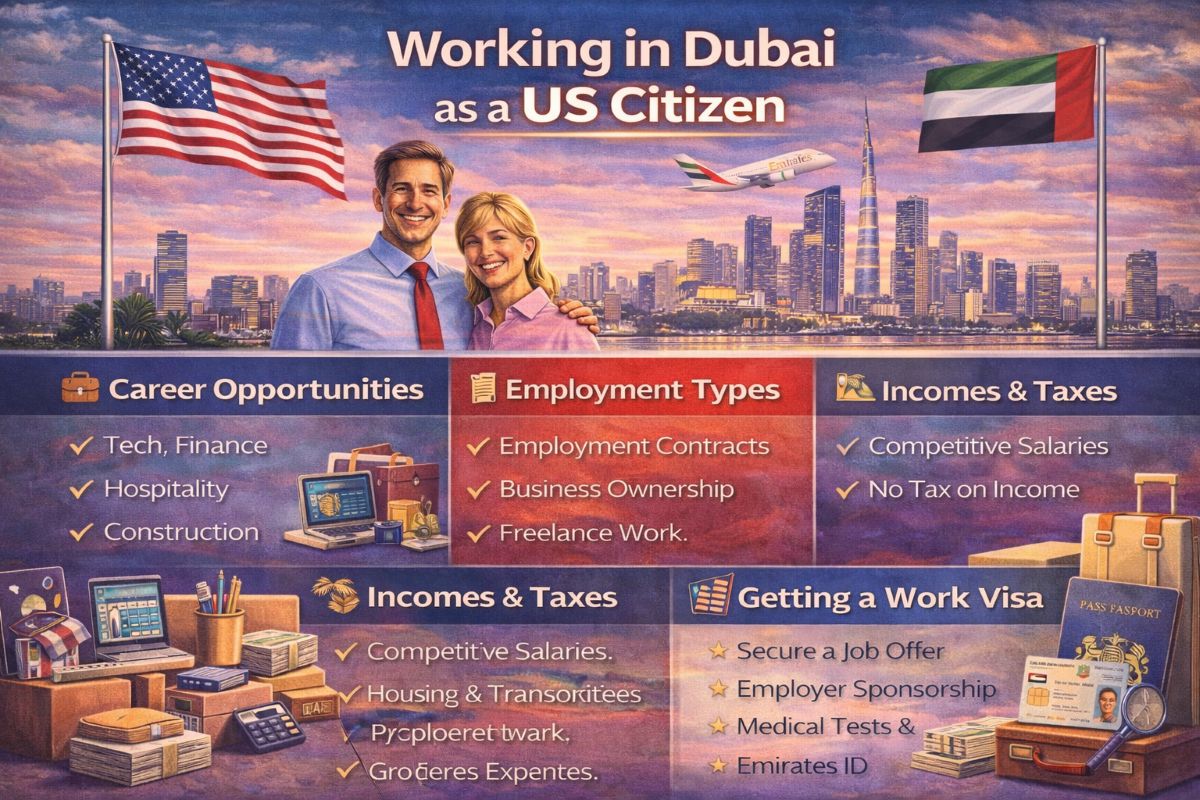
Working in Dubai as a US Citizen
For most Americans, the idea of working abroad does not start with excitement. It starts with pressure. Career paths that feel narrow, living costs that keep climbing, and the quiet sense that professional effort is no longer matched by quality of life. Working in Dubai as a US citizen enters the conversation not as a dramatic leap, but as a grounded alternative. This is not about reinvention. It is about choosing an environment where work, income, and daily life feel more balanced and more predictable.
Why working in Dubai attracts US citizens today
Americans looking at Dubai are rarely chasing novelty. They are looking for structure. Dubai offers a job market that is intentionally international, built around attracting foreign professionals rather than absorbing them reluctantly. This changes the tone immediately. US citizens working in Dubai often notice that their experience is treated as an asset, not something to be justified or translated.
Dubai positions itself as a regional headquarters city. Many global companies base Middle East, Africa, or Asia operations here. That creates demand for professionals who bring Western training, decision making confidence, and leadership experience. For Americans, this often translates into roles with responsibility from day one.
There is also a psychological shift. Work feels more contained. Clear contracts, defined expectations, and faster administrative processes reduce background stress. Over time, Americans working in Dubai often report that their professional energy is spent on output rather than navigation.
Legal framework for working in Dubai as a US citizen
Working in Dubai as a US citizen requires legal authorization. In most cases, this means employer sponsorship. A job offer is not just a formality. It is the foundation of the entire process. The employer applies for work authorization, which then links to residency and identification.
Once approved, residency unlocks practical life. Banking, housing, healthcare, and even mobile phone contracts depend on it. This centralized structure can feel strict at first, but it quickly becomes reassuring. There is little ambiguity about status or rights.
For Americans, the key adjustment is understanding that employment and residency are connected. Changing jobs requires process. Planning matters. But once the system is understood, it becomes predictable rather than restrictive.
Dubai work visa process for Americans explained simply
The work visa process in Dubai follows a clear sequence. First comes the job offer and signed employment contract. Then an entry permit or status change if already in the country. After that, medical fitness checks and biometric registration. Finally, residency issuance and work authorization.
Documents typically include a valid passport, photographs, and sometimes educational certificates depending on the role. Certain professions require degree verification. Others rely more heavily on experience. Employers guide most of this process, which reduces individual burden.
The timeline is usually measured in weeks, not months. Delays happen when documents are missing or assumptions are made. Americans who approach the process patiently tend to move through it smoothly. This is not a system that rewards shortcuts, but it does reward preparation.
Types of jobs US citizens typically get in Dubai
Americans working in Dubai are found across many sectors. Corporate leadership, finance, technology, consulting, aviation, healthcare, education, and engineering are common. The unifying factor is specialization. Dubai values skills that support growth, scale, and international operations.
Senior roles are especially common. Many Americans arrive at mid to senior career stages. Their experience fits well with companies managing regional complexity. Decision making authority is often higher than in equivalent US roles.
There are also opportunities in training, advisory, and niche expertise. Americans with strong communication skills and professional credibility often find demand in roles that bridge cultures and markets.
Can US citizens work in Dubai without a degree
Degree requirements exist, but they are not absolute. Many roles require formal education, especially regulated professions. However, experience can replace degrees in certain sectors. Technology, sales, operations, and specialized technical roles often prioritize proven capability.
Employer discretion plays a major role. Some companies are flexible if the candidate brings rare skills or leadership experience. Others adhere strictly to formal criteria. Understanding industry norms is essential.
Americans considering working in Dubai without a degree should approach the market realistically. Strong resumes, references, and clear value propositions matter more than titles. When alignment exists, pathways often open.
Employment contracts in Dubai for American expats
Employment contracts in Dubai are structured and detailed. They define salary, allowances, working hours, leave entitlement, and termination terms. Contracts are usually fixed term, with renewal options. Reading and understanding every clause is essential.
Compensation often includes more than base salary. Housing allowances, transport support, schooling contributions, and health insurance are common. These elements shape real income more than headline numbers.
Americans sometimes underestimate the importance of notice periods and exit clauses. Dubai labor rules protect both employer and employee, but expectations differ from the US. Clarity at the contract stage prevents friction later.
Salary expectations and financial reality for Americans
Dubai salaries are often described as tax free. In practice, they are tax neutral locally but still require awareness of US obligations. That said, net take home pay often feels higher due to the absence of local income tax and predictable expenses.
Compensation should be evaluated holistically. Base pay, allowances, cost of living, and lifestyle value all matter. A slightly lower salary can still result in better quality of life due to efficiency and safety.
Many Americans working in Dubai report that they save more not because they earn dramatically more, but because spending becomes more intentional. Financial planning feels calmer.
Work culture and professional expectations in Dubai
Workplaces in Dubai are multinational. Teams include professionals from dozens of countries. This diversity shapes communication. Directness is valued, but respect and awareness are essential.
Hierarchy exists, yet decision making can be faster than in large US organizations. Meetings tend to focus on outcomes. Punctuality and professionalism are expected. Americans usually adapt quickly once cultural nuances are understood.
Work life balance varies by industry, but many Americans notice clearer boundaries. Even demanding roles often allow space for personal life. This balance becomes one of the most appreciated aspects of working in Dubai.
Banking and financial setup for US citizens working in Dubai
Opening a bank account becomes possible once residency is issued. Salary payments flow through local accounts. Compliance checks are thorough, especially for US citizens. Transparency matters.
Once accounts are active, banking is efficient. Digital platforms are strong. Everyday transactions are simple. This reliability supports daily life and long term planning.
Managing finances as an American abroad requires awareness of reporting obligations. While this adds complexity, it does not cancel the practical benefits of working in Dubai.
US tax obligations while working in Dubai
US citizens remain subject to US tax reporting regardless of residence. Income earned in Dubai must be declared. This reality should be acknowledged calmly, not feared.
Working in Dubai does not eliminate responsibility, but it does change context. With proper planning, Americans often find that their overall financial position improves despite continued reporting.
The key is preparation. Understanding obligations early prevents surprises. Many Americans find that once systems are set up, tax compliance becomes routine rather than stressful.
Cost of living considerations for working Americans
Dubai is not uniformly expensive. Housing quality and location influence cost significantly. Transportation is affordable. Fuel is inexpensive. Dining options span all budgets.
Working Americans often choose housing near their workplace to reduce commute time. This improves daily rhythm. Lifestyle spending becomes more deliberate.
The real comparison is not Dubai versus the US, but effort versus outcome. Many Americans feel that what they spend in Dubai delivers more visible value.
Relocating for work with family as a US citizen
Family relocation is structured. Once the primary work visa is issued, spouses and children can be sponsored under clear rules. Documentation is required, but the process is predictable.
Schooling options include international and American curriculum schools. Families often find transitions smoother than expected. Children adapt quickly.
Working in Dubai with family often brings stability. Safety, structure, and convenience support family routines and reduce stress.
Workplace rights and protections in Dubai
Dubai labor laws define rights and obligations clearly. Contracts matter. Employers are required to meet standards. Employees have protections, but processes differ from the US.
Understanding local rules is essential. Americans sometimes assume US style flexibility applies. It does not. Respecting the framework prevents conflict.
When expectations are aligned, the system works well. Predictability replaces uncertainty.
Changing jobs and career mobility in Dubai
Changing employers is possible, but it requires proper procedure. Notice periods must be respected. Transfers involve documentation. Planning ahead is essential.
Career mobility exists, especially for skilled professionals. Dubai values experience and reputation. Networks matter.
Many Americans find that their career accelerates once they understand how the market works.
Common mistakes Americans make when working in Dubai
Starting work without proper authorization
Assuming contracts are informal
Underestimating documentation requirements
Misjudging cost of living dynamics
Avoiding these mistakes comes down to patience and clarity.
Who working in Dubai works best for
Working in Dubai suits Americans who value structure, safety, and international exposure. It fits professionals who think long term and plan deliberately.
Those seeking chaos or constant change may struggle. Dubai rewards consistency rather than improvisation.
Alignment matters more than ambition.
Summary
Working in Dubai as a US citizen is not complicated, but it is structured. Those who prepare carefully and respect the system often find that work becomes more focused, life more predictable, and planning more intentional. Dubai does not remove effort. It removes unnecessary friction. For many Americans, that difference is enough to make the move worthwhile.