
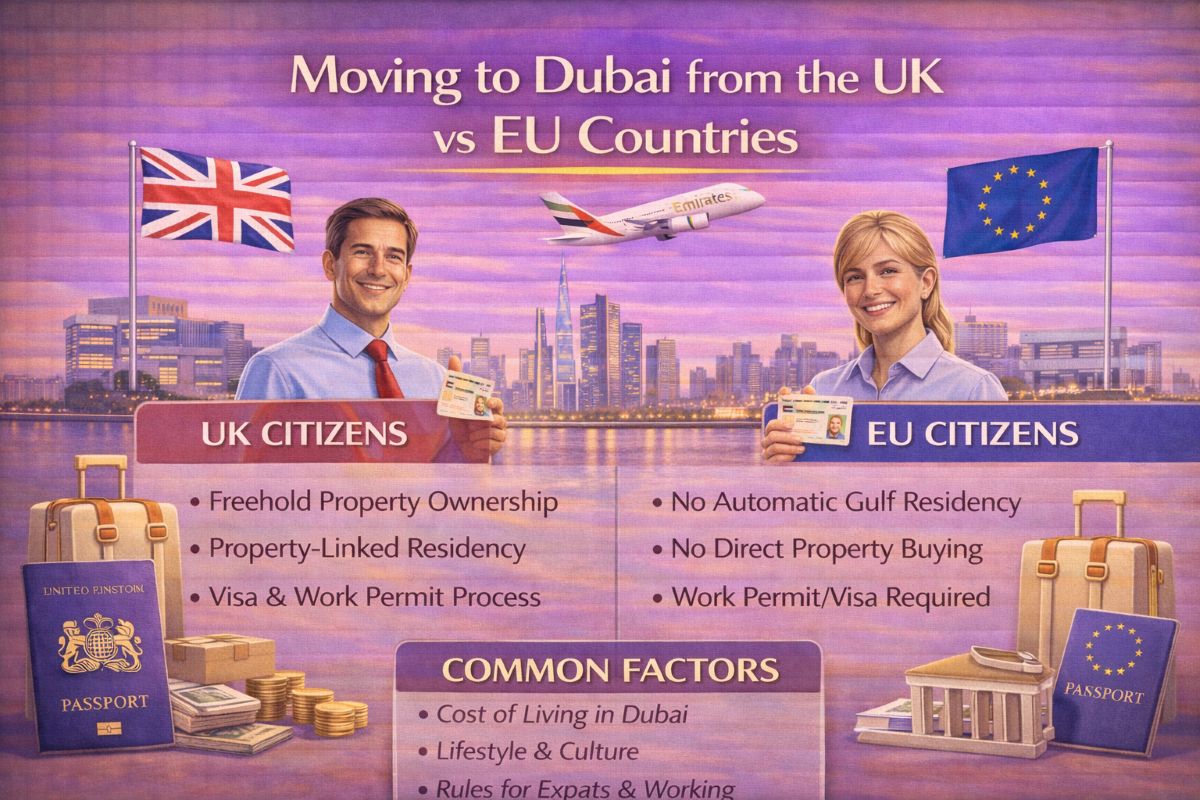
Moving to Dubai from the UK vs EU Countries: What’s Different for British Citizens?
People like to simplify relocation. A visa, a flight, a new apartment, and suddenly you’re living in Dubai. Then you talk to a friend moving from Spain or Germany and you notice something. You are both going to the same city, you are both dealing with the same UAE rules, but the process feels different. Not dramatically. Just enough that you feel it in timelines, paperwork, and how many times you have to prove the same thing.
This is exactly what people search for when they type moving to Dubai from the UK vs EU countries, or what’s different for British citizens in Dubai. They’re not looking for theory. They want the real friction points, the stuff that delays a bank account, slows down family visas, or makes an employer nervous because HR has seen the EU version a hundred times and the UK version only a few.
Let’s go through it like a proper consultation. We will keep it grounded. We will not overpromise. And we will focus on what actually changes when the starting point is the UK rather than an EU country.
Why moving to Dubai from the UK feels different than from EU countries
Dubai does not run two separate immigration systems, one for the UK and one for the EU. The UAE rules are broadly the same. Residency routes, employer sponsorship, investor visas, Golden Visa options, Emirates ID, medical tests, health insurance. These are the same building blocks for everyone. So where does the difference come from.
It comes from what you carry with you into the process. Your home country paperwork culture, document formats, the way authorities verify identity, and how banks interpret risk. An EU citizen might have documents that local teams in Dubai see every day. A British citizen might have documents that are perfectly valid, but less familiar to the person reviewing them. That unfamiliarity creates questions. Questions create delays.
The most common areas where Brits feel the UK vs EU difference are
- document attestation and legalisation steps
- proof of address expectations and document style
- bank compliance and source of funds questions
- tax residency planning and exit strategy discipline
None of this is meant to scare you. It just means the UK route benefits more from early preparation.
Visa pathways that are the same for British citizens and EU nationals
Most expats arrive in Dubai through the same core visa routes. Employment based residency, business owner residency, investor or partner visas, freelance permits, sometimes property linked residency depending on the setup, and for some profiles the Golden Visa route. If you have a job offer, the employer sponsors. If you have a company, the company sponsors you. If you invest, you build a residency route around that.
This is where people sometimes get it wrong. They assume EU nationals have a special advantage in UAE visas. Usually they do not. The UAE does not function like Europe. EU freedom of movement is an EU concept. Dubai is outside that framework.
So the difference is not the visa category. The difference is the processing friction around it, and the most useful mindset is this
choose the best visa route for your life plan first
then prepare your UK or EU documents to fit that route cleanly
That one shift saves time. It also reduces stress because you stop comparing passports and start comparing readiness.
Employment relocation for Brits vs EU citizens in Dubai
If you are moving to Dubai for work, the employer sponsorship process is structurally the same. But the experience can feel different depending on how familiar the HR team is with your documents. EU degrees, EU police certificates, EU civil documents. Many employers have internal checklists that match those formats closely. UK documents are still accepted, but you may get more follow up questions.
A classic example is educational documents. Some roles require attested degrees. A British citizen may need to manage attestation steps in a specific chain, and if that chain starts late, the visa timeline can stretch. EU citizens can face the same requirement, but document issuance and local legalisation steps vary by country and some are faster.
Another difference is the way employers evaluate work history. UK experience letters, job titles, and payroll records might look different from what HR teams expect. This is not a judgement. It is a format issue. And format issues cause delays in corporate environments.
For employment based relocation, the practical checklist looks like this
- degree and transcript readiness if required
- experience letters aligned with passport name format
- police clearance planning if needed
- marriage and birth certificates ready if family is coming
The smoother your package, the less nationality matters.
Business setup differences for UK founders compared with EU founders
Company formation in Dubai is the same menu for UK and EU founders. Mainland, free zone, offshore. The real question is what you want to do, where you want to sell, and how you want to bank. That said, UK founders often experience a slightly different banking and compliance journey compared to some EU founders.
UK corporate paperwork is clean, but the UK structure ecosystem can be complex. If income comes through multiple entities, or there are legacy holdings, or there is a mixture of personal and business revenue, banks may ask more detailed source of funds questions. EU founders can face similar questions, especially those operating across several EU jurisdictions, but the patterns differ.
The other thing we see in practice is familiarity. Some free zones and service providers have long routines for certain EU nationalities because they are common. UK founders still have strong acceptance, but the staff may not have muscle memory for every UK document type.
If you are setting up a business, the high impact preparation areas are
- clear description of the business model and expected transactions
- clean proof of income and source of funds story
- simple shareholder and signing authority structure
- attested corporate documents if needed for banking
When those are in place, UK vs EU becomes a small detail.
Document requirements and why UK vs EU really shows up here
If we are honest, documents are the battlefield. Not the sexy part, but the part that decides speed. Document attestation, legalisation, and translation can make a relocation feel smooth or painfully slow. This is where moving to Dubai from the UK vs EU countries becomes a real comparison.
The UAE expects foreign documents to be verified. That is true for everyone. But each country issues documents differently, and each country has its own legalisation habits. Some EU countries have systems that integrate quickly with international legalisation. Others are slower. The UK is reliable but can require strict sequencing, especially when multiple documents are involved.
There are three main document categories that trigger delays
- civil documents such as marriage and birth certificates
- education documents such as degrees and professional qualifications
- corporate documents such as incorporation papers, resolutions, powers of attorney
And then translation can become the silent trap. Some documents require certified legal translation into Arabic. People assume any translation is fine. It is not. The translator needs to be accepted and the format needs to match local expectations.
Banking in Dubai and how UK vs EU background influences approvals
Dubai banking is not about nationality. It is about clarity. Banks want to understand who you are, where your money comes from, and what you intend to do with the account. That is compliance. And compliance is the real gatekeeper.
UK citizens sometimes face detailed questions because the UK is a global financial hub and many individuals have cross border income, investment accounts, or structures. EU citizens sometimes face detailed questions because they may have multi country income inside the EU. Both can be approved. The difference is the story you present and how cleanly you can document it.
Personal accounts and corporate accounts behave differently. Personal accounts often open faster once you have Emirates ID and a stable residency. Corporate accounts can take longer because banks assess the business model, expected cash flow, and counterparties.
If you want to reduce friction, focus on these documents early
- proof of address that banks accept
- clear salary evidence or business income evidence
- source of funds documentation that matches your profile
- a realistic explanation of expected monthly activity
When banks feel clarity, approvals accelerate.
Tax residency planning is not symmetrical for UK and EU citizens
This is where you stop comparing Dubai rules and start comparing home country rules. Dubai does not automatically make you tax free. Your home country decides when you stop being tax resident there. And the UK has its own residency tests, ties, and patterns. EU countries also have their own rules, but they vary widely.
For British citizens, the discipline often comes down to days and ties. Where the family is. Where the home is. Where the work is performed. Where the business is managed. These details matter because they shape your tax residency status.
EU citizens can face similar issues, but some EU countries apply different principles such as centre of vital interests, habitual residence, or stricter exit frameworks. This is why moving to Dubai from the UK vs EU countries is not a simple comparison. It depends on which EU country you are comparing with.
The best approach is always the same
- plan Dubai residency and home country tax residency together
- document your relocation as a real life change, not just a travel pattern
- avoid leaving loose ends that keep you tied to the old system
That creates long term calm.
Costs and timelines that differ subtly between UK and EU relocations
Visa fees, Emirates ID costs, medical tests, and mandatory health insurance. These are broadly the same. The difference often appears in the hidden administrative layer. Attestation fees. Translation fees. Courier fees. Re issuance of documents due to name mismatches.
Timelines can also differ because the speed of obtaining documents at home varies. Some EU countries issue civil certificates quickly and digitally. Some are slower. The UK can be efficient, but getting the right version of a document and running it through the right chain can take time if you start late.
A realistic relocation budget should include
- visa and Emirates ID expenses
- insurance costs for you and your dependants
- document attestation and legal translation costs
- bank account setup time and possible extra compliance steps
When you budget for the real process, you stop feeling surprised.
Lifestyle setup differences that British citizens notice
Once you are in Dubai, the differences fade. Everyone ends up in the same system. Emirates ID becomes the equaliser. Your nationality matters less in daily life, and your resident status matters more.
Still, British citizens often notice certain lifestyle adjustments more sharply because the UK system is so familiar. The insurance based healthcare model. The reliance on Emirates ID for everything. The way tenancy registration and utilities are tied to residency. It is not complicated, but it is different.
And then there is the human side. British communities in Dubai are strong and visible, which makes social settling easier. EU communities exist too, often by language. But the ease of integration is rarely the problem. The paperwork and compliance are where the stress lives.
Common mistakes when comparing UK vs EU relocation to Dubai
The biggest mistake is focusing on the passport and ignoring the preparation. The second biggest is assuming that an EU citizen will automatically have an easier time. Sometimes they do, sometimes they do not, and often it depends on the individual profile more than the nationality.
Typical mistakes include
- starting document attestation too late
- treating banking as a formality
- ignoring home country tax residency planning
- not aligning the visa route with the real life plan
- bringing family without having civil documents ready
Fix these and most relocation stress disappears.
A practical decision framework for British citizens comparing UK vs EU routes
If you are a British citizen, the smartest way to use this UK vs EU comparison is not to worry about fairness, but to anticipate friction. Think in terms of projects. Visa project. Banking project. Document project. Tax project. Each one has its own timeline.
Ask yourself quietly
- am I moving as an employee, founder, investor, or retiree
- do I need family sponsorship right away
- how clean is my income story on paper
- do I need corporate banking fast
- how quickly can I produce and legalise documents
When you answer those honestly, the path becomes clearer.
Conclusion
Moving to Dubai from the UK vs EU countries looks similar on the surface, but British citizens often feel the difference in document legalisation, banking compliance, and home country tax planning. Dubai is not the hard part. The preparation is. When we start early with documents, align residency with tax reality, and treat banking as a structured process, the UK route becomes just as smooth as any EU relocation, sometimes smoother.