
Dubai’s Community Development Authority Reveals 8th Social Survey Results
The Community Development Authority (CDA) in Dubai recently released the findings from the eighth Social Survey (2024–2025), demonstrating the emirate’s dedication to creating a data-driven social development framework. This initiative is closely aligned with the goals established in the Dubai Social Agenda 33, focusing on enhancing family stability and fostering social cohesion during the ‘Year of the Family’.
The Importance of the Social Survey
According to Her Excellency Hessa bint Essa Buhumaid, the Director General of the CDA, the Social Survey functions as a vital analytical tool, helping the government to comprehend social trends and project future requirements. The survey’s comprehensive approach employs data to formulate effective policies that address people’s needs. According to Her Excellency Buhumaid, “The outcomes of this eighth cycle confirm Dubai’s steady progression toward its development objectives, with a focus on prioritizing families and individuals. This focus elevates the quality of life and strengthens societal stability in accordance with the Dubai Social Agenda 33.”
The Social Survey provides an essential national perspective on Dubai’s society, capturing essential metrics such as quality of life, social cohesion, and well-being. This data is crucial for shaping impactful social policies.
Key Findings from the Survey
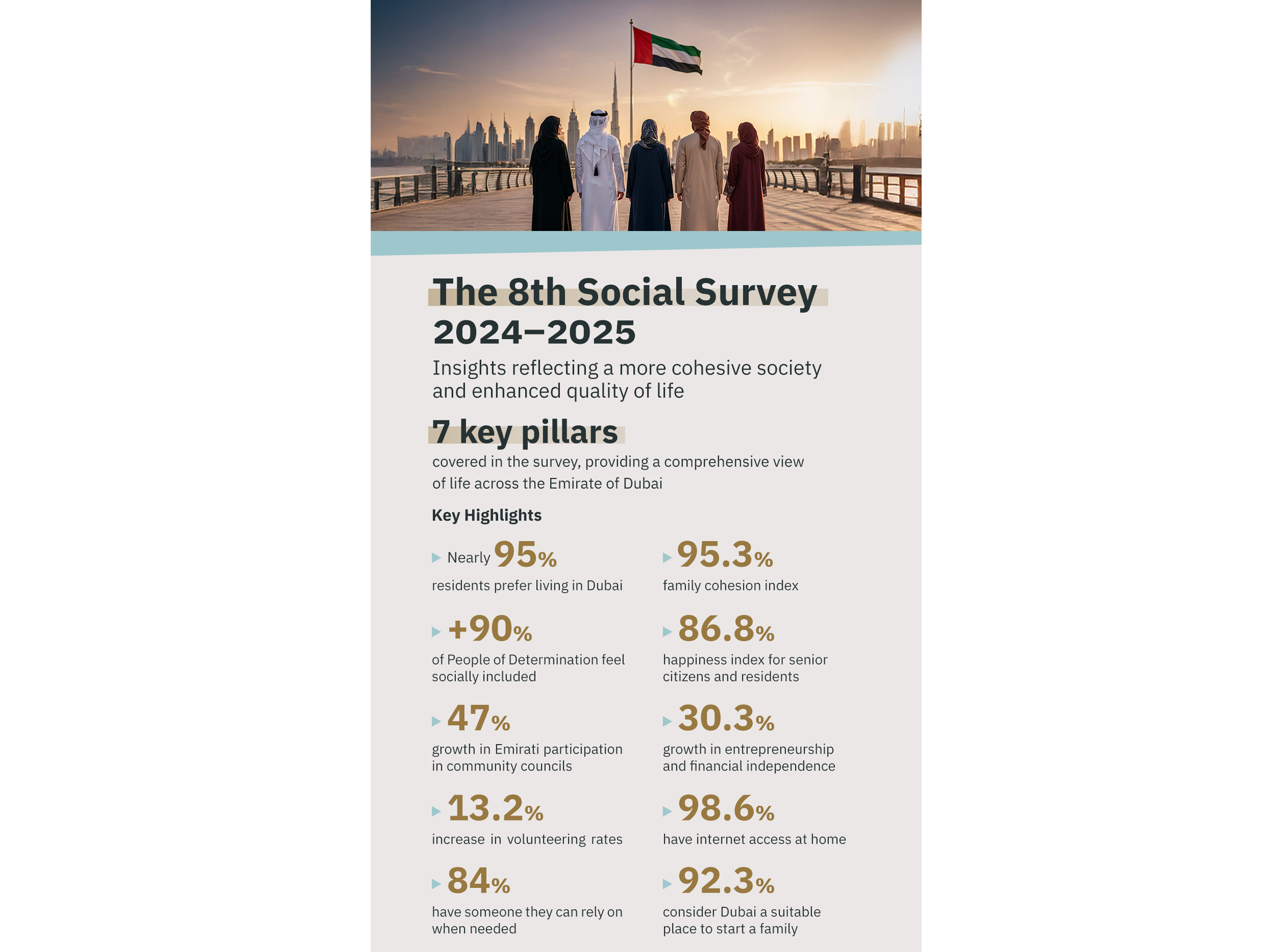
One of the survey’s seven pillars is quality of life, which has shown notable improvement. The average happiness score among residents stands at 8.6, with overall life satisfaction rated at 8.72 out of 10. This high level of well-being illustrates Dubai’s reputation as a preferred living destination for approximately 95% of its residents. Indicators such as safety and religious freedom have contributed to the public’s trust and favorable living conditions in the emirate. Moreover, an impressive 96.4% of residents express pride in living in Dubai, highlighting the emirate’s inclusive social fabric. The happiness index for senior citizens also underscores a high quality of life within this demographic.
Family cohesion and social solidarity are other critical pillars examined in the survey. The Family Bond Index has reached 95.3%, emphasizing the family’s role as a foundational element of social stability. Additionally, the social support indicator shows that 84% of the community feels they have someone to rely on, indicating strong social bonds. The survey also recorded a significant rise in volunteerism, from 8.4% to 13.2%, which reflects a growing culture of giving back and societal responsibility.
Social Inclusion and Community Engagement
In terms of social inclusion, over 90% of People of Determination feel integrated within Dubai’s community, which showcases the emirate’s commitment to inclusivity. Moreover, more than 90% of respondents reported access to educational opportunities and essential services, underlining the supportive nature of the environment for all community members.
Community Majalis, important cultural gatherings in Dubai, have also noted a surge in involvement and awareness. The recognition of their significance has jumped from 87% in 2022 to 92.6% in 2024. Attendance among Emiratis at these gatherings has risen 47% in the past few years, reinforcing their role as crucial places for dialogue and social engagement.
Financial Well-Being and Advanced Digital Infrastructure
The pillar focusing on social needs and financial well-being indicates diverse entrepreneurial motivations, with 30.3% of Emiratis expressing interest in borrowing to start their own businesses. This represents an evolving mindset towards financial autonomy. The survey also revealed outstanding internet accessibility, with 98.6% of the population having home internet, a testament to Dubai’s advanced digital infrastructure.
The eighth Social Survey utilized sophisticated methodologies, including enhanced statistical tools that improve the accuracy of insights. An interactive dashboard was created to make these results accessible, facilitating transparency and knowledge-sharing among stakeholders. Overall, these findings provide a solid foundation for developing social policies while enhancing planning efforts to be more attuned to community needs.