
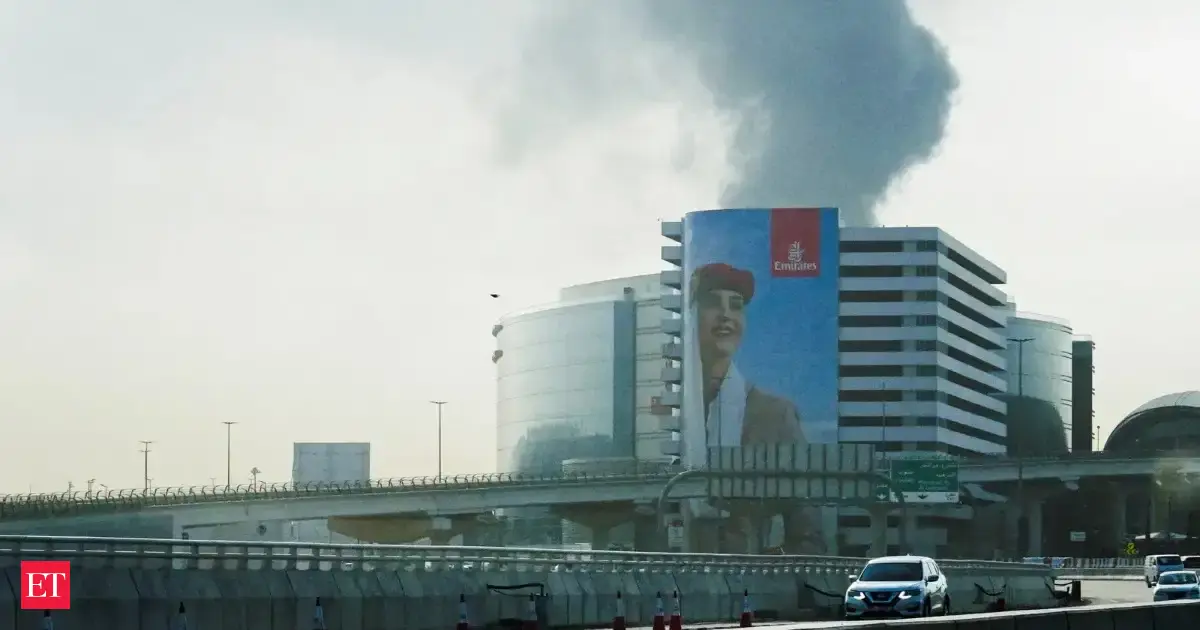
UAE Suspends Foreign Airlines at Dubai Airports Following Drone Incident
Dubai Airport has taken the significant step of indefinitely halting all operations for foreign airlines, stalling hopes for a swift recovery in the aviation sector. This decision comes on the heels of a drone attack that led to a fuel tank fire, forcing a temporary shutdown of operations. While flights had started to resume gradually, the latest announcement from the General Civil Aviation Authority (GCAA) of the United Arab Emirates has now put a halt to any foreign carriers landing or taking off, with no specific timeline for when restrictions might ease.
Impact on Indian Airlines
The ban represents a considerable setback for Indian airlines that had been cautiously re-establishing service routes. Statistics from the International Air Transport Association (IATA) reveal that over 30% of India’s international air traffic originates from the Middle East, with Dubai being a crucial hub. Notably, the routes from Dubai to major Indian cities like Mumbai and Delhi were pre-war among the busiest international paths, accounting for around 4.9% of all flights from India.
Indian airline officials have criticized the decision, arguing that it creates an unfair competitive environment. While Emirates and Flydubai—Dubai’s national carriers—can operate without restrictions, foreign airlines are limited significantly. This one-sided approach has been described as a serious distortion of the competitive landscape, as Indian airlines are unable to operate on equal footing when facing a flood of flights from their Dubai counterparts.
Previous Air Corridor Openings
Earlier in March, the UAE had announced the opening of safe air corridors enabling airlines to operate up to 48 flights per hour, signifying an optimistic approach aimed at revitalizing air travel. However, the GCAA imposed limitations on foreign airlines, permitting just one flight per day. This disparity raises questions, especially since Indian airlines have been advocating for a fairer distribution of flight rights. An official from an Indian carrier emphasized that the unequal opportunity, with Emirates operating numerous daily flights while Indian counterparts have limited access, contradicts fair play in the industry.
A Prolonged Aeropolitical Rivalry
The tensions between Indian and Dubai carriers have been brewing for quite some time. Emirates’ president, Tim Clark, has voiced concerns about India’s reluctance to allow an increase in flights—an issue that has persisted for over 12 years. The last increase in flying rights was recorded back in 2013, highlighting the stagnation in the air travel relationship between the two nations. The GCAA recently revealed that UAE national carriers have recovered approximately 44.6% of their pre-war operational levels, further accentuating the imbalance in air traffic activity.
In light of these developments, Indian airlines may need to engage more actively with their government to address the current limitations. The focus should be on ensuring a fair and equitable environment for all carriers, thereby fostering healthy competition and rebuilding the aviation sector. Without a resolution, the broader implications for international travel and trade could remain unfavorable for many stakeholders involved.