
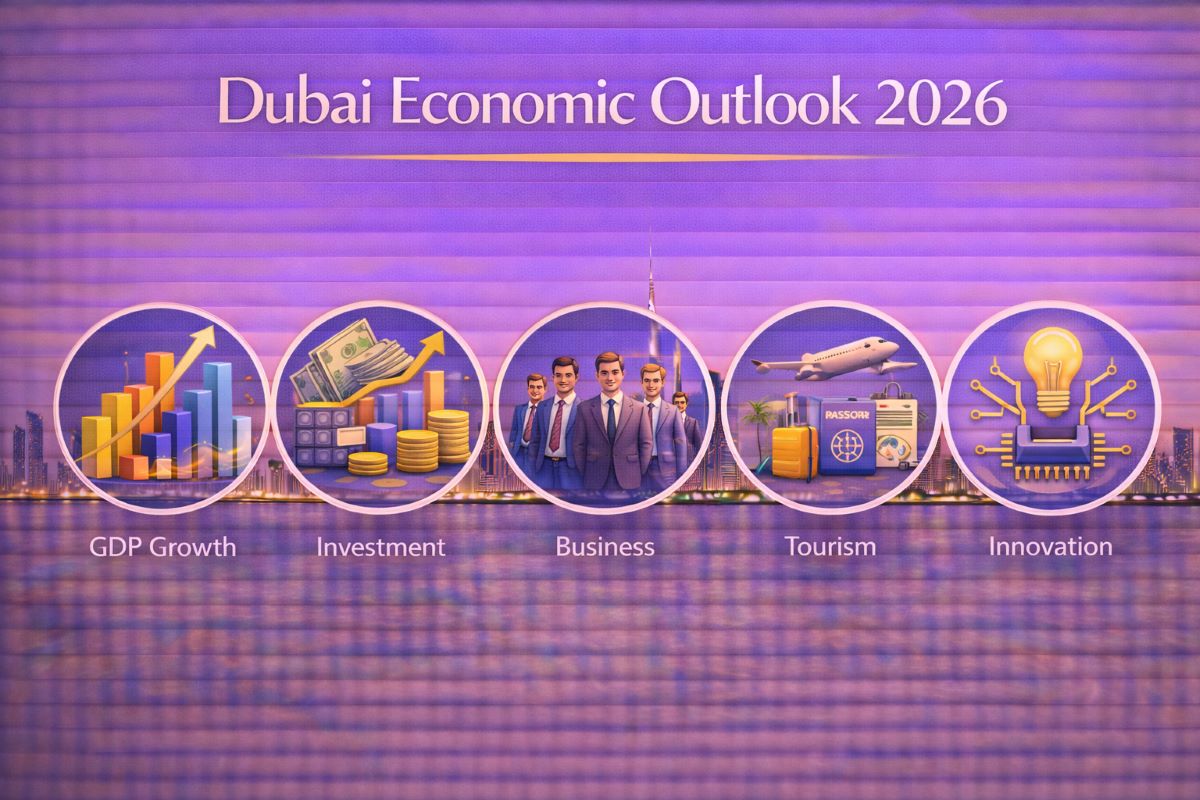
Dubai economic outlook 2026
Dubai enters 2026 with strong momentum, backed by long-term planning, economic diversification, and a clear vision for sustainable growth. For investors, entrepreneurs, and global businesses, understanding the Dubai economic outlook 2026 is not only about macroeconomic forecasts, but about identifying where opportunities, risks, and structural advantages truly lie. The city has moved beyond its traditional dependence on real estate and trade alone, positioning itself as a multi-sector global hub.
This in-depth overview explores Dubai’s economic outlook in 2026 from multiple angles, including growth drivers, sector performance, investment climate, risks, and long-term implications. It is designed for readers seeking clarity, context, and strategic insight rather than surface-level predictions.
Understanding the Dubai economic outlook 2026
The Dubai economic outlook 2026 reflects a transition from rapid expansion to sustainable, diversified growth. The economy is increasingly driven by non-oil sectors, innovation, foreign investment, and global connectivity. This shift provides resilience against external shocks and global economic volatility.
Dubai’s leadership has prioritized predictability, policy continuity, and long-term competitiveness. As a result, economic planning is not reactive but strategic, allowing businesses and investors to plan with confidence. The outlook for 2026 is shaped by both internal reforms and external demand for Dubai as a business, tourism, and investment destination.
From a search intent perspective, people looking at the Dubai economic outlook want answers to practical questions: Is growth sustainable? Which sectors will lead? How safe is Dubai in a global slowdown? These questions are best answered through a holistic economic view rather than isolated data points.
Key growth drivers shaping Dubai’s economy in 2026
Several structural drivers underpin the Dubai economic outlook 2026. The most important is diversification. Non-oil activities now dominate economic output, reducing exposure to commodity cycles and enhancing long-term stability.
Another major driver is population growth fueled by skilled migration, business relocation, and long-term residency programs. A growing population increases consumption, housing demand, and service-sector activity, reinforcing economic expansion.
Key growth drivers include:
- economic diversification across services, trade, finance, and technology
- government-led infrastructure and urban development
- talent attraction and flexible residency frameworks
- pro-business regulations and digital government services
Together, these drivers create a self-reinforcing growth environment.
Dubai GDP growth outlook and macroeconomic performance
Dubai’s GDP growth outlook for 2026 remains positive, supported by domestic consumption, foreign investment, and trade activity. While global growth may moderate, Dubai’s economy benefits from its role as a regional and international gateway.
Non-oil sectors contribute the majority of GDP, including trade, logistics, tourism, financial services, and real estate-related activities. This diversified base enhances resilience and smooths economic cycles.
The Dubai economic outlook 2026 is characterized not by explosive growth, but by steady, high-quality expansion, which is often more attractive to long-term investors and businesses.
The role of the D33 agenda in Dubai’s economic outlook
The Dubai Economic Agenda D33 plays a central role in shaping the economic outlook toward and beyond 2026. The strategy aims to significantly expand the size of the economy through productivity, innovation, and global integration.
D33 focuses on:
- strengthening Dubai’s position as a global trade hub
- accelerating digital and technological transformation
- supporting private sector growth
- attracting foreign direct investment
This long-term roadmap provides clarity and confidence, aligning public and private sector objectives.
Foreign direct investment and global capital inflows
Foreign direct investment is a cornerstone of the Dubai economic outlook 2026. Dubai continues to attract global capital due to its stability, transparency, and strategic location.
Investors are drawn by:
- full foreign ownership in most sectors
- competitive tax environment
- efficient licensing and regulatory processes
- access to regional and global markets
FDI inflows support job creation, innovation, and sectoral growth, reinforcing Dubai’s international economic relevance.
Business environment and entrepreneurship outlook in Dubai
Dubai’s business environment in 2026 remains one of the most competitive globally. Entrepreneurs benefit from streamlined company formation, flexible business structures, and strong institutional support.
Startups, SMEs, and multinational companies all find space within Dubai’s ecosystem. Free Zones and Mainland structures allow tailored setups depending on operational needs.
The entrepreneurial outlook is strengthened by:
- ease of doing business
- access to funding and talent
- government-backed innovation initiatives
This makes Dubai attractive for both first-time founders and experienced operators.
Real estate and its role in the Dubai economic outlook 2026
Real estate remains a significant contributor to Dubai’s economy, but its role has evolved. Instead of speculative growth, the market now supports population growth, business relocation, and lifestyle demand.
Residential, commercial, and mixed-use developments drive employment and investment, while strong regulation enhances market stability. Real estate acts as both an economic engine and a reflection of broader economic health.
In the Dubai economic outlook 2026, real estate is a supporting pillar, not the sole driver.
Tourism and hospitality as growth engines
Tourism continues to play a vital role in Dubai’s economic outlook. The city has positioned itself as a year-round destination for leisure, business travel, and global events.
Hospitality, retail, and entertainment sectors benefit directly from tourism activity, generating employment and foreign exchange inflows.
Key strengths include:
- diversified tourism offerings
- strong global brand positioning
- continuous investment in attractions and infrastructure
Tourism supports both short-term economic activity and long-term city branding.
Trade, logistics, and global connectivity
Dubai’s economy is deeply integrated into global trade networks. Its ports, airports, and logistics infrastructure make it a leading re-export and distribution hub.
Trade and logistics support multiple sectors, from manufacturing and e-commerce to food security and healthcare supply chains. This connectivity enhances Dubai’s resilience in global supply chain shifts.
In 2026, logistics remains a stable, growth-oriented component of the Dubai economic outlook.
Financial services, fintech, and capital markets
The financial sector continues to expand, driven by regional wealth, international capital flows, and fintech innovation. Dubai serves as a financial gateway connecting East and West.
Digital finance, payments, and wealth management services are gaining prominence, supported by regulatory innovation and strong compliance frameworks.
Financial services enhance capital availability across the economy, amplifying growth in other sectors.
Technology, innovation, and the digital economy
Technology plays an increasingly central role in the Dubai economic outlook 2026. Artificial intelligence, automation, and smart city solutions are embedded across public and private sectors.
Innovation-driven growth improves productivity and competitiveness, supporting long-term economic resilience.
Technology-related growth areas include:
- digital services and platforms
- AI-driven business solutions
- data analytics and cybersecurity
- smart infrastructure
This shift strengthens Dubai’s knowledge-based economy.
Sustainability and the green economy
Sustainability is no longer optional in Dubai’s economic planning. Green energy, resource efficiency, and ESG-driven initiatives are integrated into long-term development.
Investment in clean technology and sustainable infrastructure supports environmental goals while creating new economic opportunities.
The green economy adds depth and future-proofing to the Dubai economic outlook 2026.
Labor market, talent attraction, and population trends
Dubai’s labor market continues to expand, supported by skilled migration and flexible visa frameworks. Talent attraction is a competitive advantage that fuels productivity and innovation.
A growing workforce supports consumption, housing demand, and service-sector growth, reinforcing economic expansion.
Population growth remains a structural driver of long-term economic performance.
Inflation, cost of living, and monetary conditions
Inflation in Dubai remains relatively controlled compared to many global markets. While cost of living pressures exist, wage growth and economic activity help maintain purchasing power.
Interest rate conditions influence borrowing and investment decisions, but Dubai’s diversified economy reduces vulnerability to monetary tightening.
Stable price dynamics support consumer confidence and business planning.
Risks and challenges in the Dubai economic outlook
Despite strong fundamentals, Dubai faces risks such as global economic slowdowns, geopolitical tensions, and sector-specific oversupply. Competition from other global hubs also requires continuous adaptation.
However, proactive policy responses and diversification reduce systemic risk.
Understanding risks allows investors and businesses to plan strategically rather than react defensively.
Opportunities for investors and businesses in 2026
The Dubai economic outlook 2026 presents opportunities across technology, logistics, real estate services, finance, tourism, and sustainability-driven sectors.
Opportunities are strongest where government priorities align with private investment and global demand.
Strategic positioning remains key to capturing these opportunities.
Dubai economic outlook 2026 for foreign entrepreneurs
For foreign entrepreneurs, Dubai offers scalability, tax efficiency, and regional access. The outlook supports both local operations and global expansion.
Dubai’s economic model favors long-term commitment and innovation-driven businesses.
Summary
The Dubai economic outlook 2026 is defined by diversification, resilience, and strategic growth. Supported by strong governance, global connectivity, and long-term planning, Dubai continues to outperform many global peers in adaptability and opportunity. For investors, entrepreneurs, and businesses, understanding these dynamics is essential for making informed, future-oriented decisions.