
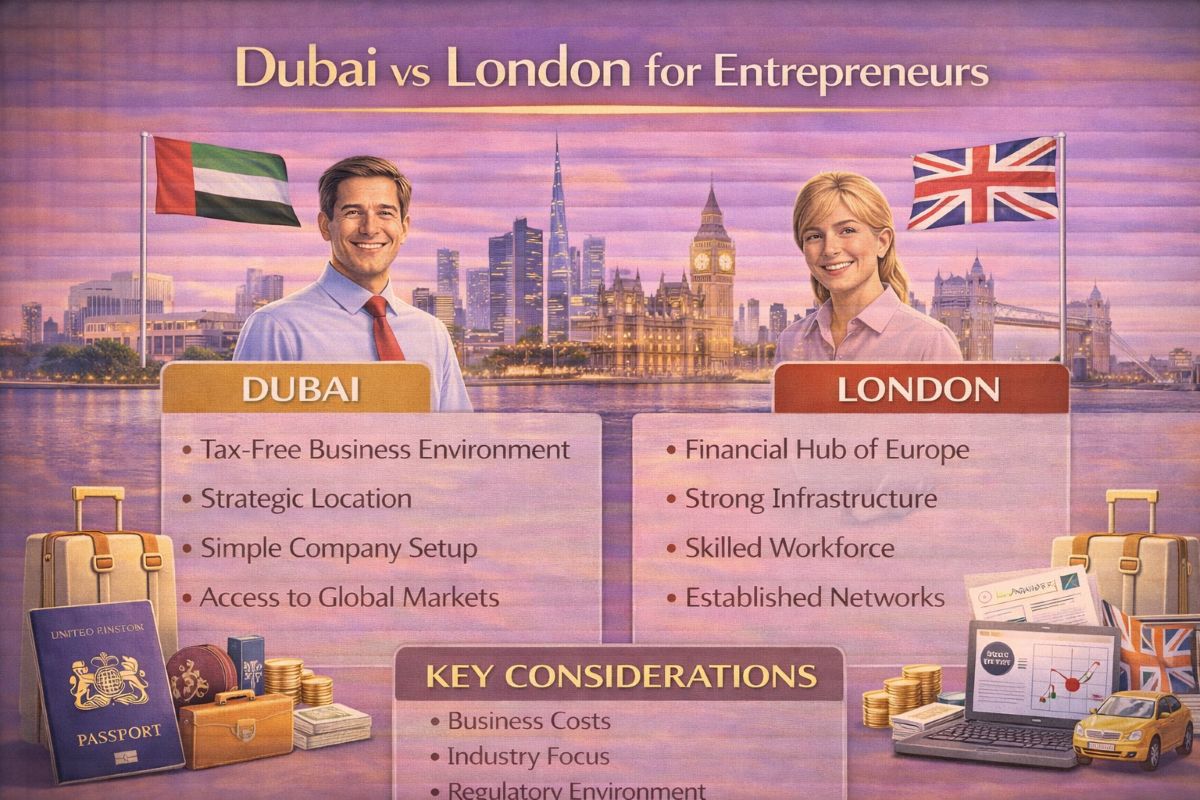
Dubai vs London for Entrepreneurs: Why British Founders Are Relocating?
Before we go any further, let’s ground this conversation. This topic rarely starts with tax calculators or corporate structures. It usually begins with a quieter moment. A late evening after work, a look at the numbers, and the strange feeling that despite doing everything right, things are getting heavier instead of easier. London hasn’t suddenly become a bad place to do business. It has become a difficult place to breathe as a founder. And this is exactly where the Dubai vs London for entrepreneurs question naturally shows up, not dramatically, just persistently.
The macro environment behind the Dubai vs London shift for entrepreneurs
London remains a global financial centre, but it is now a highly saturated one. For British founders, the UK market often feels crowded, expensive, and structurally resistant to speed. Growth is still possible, but it tends to be incremental, compliance driven, and mentally draining. Regulatory complexity, frequent policy changes, and an underlying assumption that businesses should absorb more cost have become part of the everyday background noise. You don’t always notice it immediately. You notice it when decisions take longer, when margins tighten, when planning feels reactive instead of strategic.
Dubai operates in almost the opposite direction. The economy is expansion-oriented by design. Government policy, infrastructure development, and regulatory updates tend to move in the same direction, not against each other. This alignment creates a very different entrepreneurial atmosphere. You feel it early on. Processes are clearer. Timelines are shorter. The system feels as if it expects growth rather than questions it. That alone changes how founders think about risk and opportunity.
What matters most here is not hype, but momentum. In the Dubai vs London entrepreneur comparison, Dubai’s macro environment offers something London currently struggles with. A sense that the next five to ten years are being actively built, not merely managed. For British founders who think in longer cycles, this future-facing posture is often the first serious signal that relocation might not be a lifestyle move, but a strategic one.
Tax efficiency and financial reality in the Dubai vs London entrepreneur decision
In the UK, taxation is rarely the headline problem. It’s the accumulation. Corporation tax, dividend tax, personal income tax, National Insurance. Each element on its own is manageable, but together they quietly reshape behaviour. British entrepreneurs often find themselves reinvesting less, taking fewer risks, and structuring their income defensively. Not because they want to, but because the system rewards caution over ambition.
Dubai offers a very different financial psychology. The absence of personal income tax changes more than just take-home pay. It changes how founders think. Profits feel like resources rather than liabilities. Cash flow planning becomes clearer. Long-term projections stop being exercises in damage control. Even with the introduction of corporate tax, the structure remains predictable and comparatively light, especially when viewed against London’s layered tax environment.
For many British founders, this is where the Dubai vs London entrepreneur conversation becomes real. Not ideological, not political, just practical. When you retain more of what you earn, you gain optionality. You can hire earlier, expand faster, or simply operate with less stress. That financial breathing room often unlocks better decisions, not just better numbers.
Company formation and operational friction in Dubai vs London
Setting up and running a business in London is rarely difficult in theory. In practice, it is slow. Incorporation is straightforward, but ongoing administration is not. Reporting obligations, accounting complexity, and compliance updates consume time and attention. Banking can be particularly frustrating, especially for growing companies or international structures. Accounts get reviewed, paused, or questioned with little warning, and founders learn to factor uncertainty into daily operations.
Dubai’s company formation ecosystem is built around speed and clarity. Whether through free zones or mainland structures, the emphasis is on enabling activity rather than monitoring intent. Processes are modular, often bundled, and designed to scale with the business. This does not mean a lack of regulation. It means regulation with a visible logic. You know what is expected, and you know when it will be reviewed.
In the Dubai vs London entrepreneur comparison, this operational smoothness matters more than most people anticipate. Less friction means fewer distractions. Founders spend more time building and less time managing paperwork. Over months and years, that difference compounds quietly but powerfully.
Lifestyle economics and founder psychology
London’s cost of living has become part of the entrepreneurial stress equation. Housing, schooling, transportation, and everyday expenses create constant pressure, especially for founders who reinvest heavily into their companies. Even successful entrepreneurs often feel financially constrained relative to their workload and responsibility. The city demands a lot, and increasingly, it gives less margin in return.
Dubai reframes this equation. Higher disposable income, modern infrastructure, and a service-driven environment reduce daily friction. Safety, convenience, and efficiency are not luxuries here, they are baseline expectations. This doesn’t mean Dubai is cheap. It means value is clearer. What you pay for is visible, functional, and predictable.
This shift has psychological consequences. Founders who relocate often describe thinking more clearly, sleeping better, and feeling less defensive about money. In the Dubai vs London entrepreneur discussion, this mental clarity is rarely highlighted, yet it is often the deciding factor.
Talent, teams, and scalability across borders
Hiring in London comes with undeniable advantages. The talent pool is deep, experienced, and globally respected. But it is also expensive and increasingly risk-averse. Payroll taxes, employment protections, and cultural expectations raise the cost of scaling teams. Founders become cautious, delaying hires or outsourcing key roles.
Dubai offers access to a global workforce with far greater flexibility. Teams are international by default. Employment structures are clearer. Visa systems are tied directly to business needs. This allows founders to scale gradually, intentionally, and without committing to unsustainable fixed costs too early.
From a Dubai vs London entrepreneur perspective, scalability is not just about growth potential. It’s about growth control. Being able to adjust team size, skill mix, and geography without excessive friction changes how businesses evolve over time.
Residency, stability, and long-term planning
In the UK, long-term planning feels increasingly uncertain. Policy shifts, tax changes, and regulatory updates create a sense that founders must constantly adapt. Residency is never in question, but stability often is. Many British entrepreneurs quietly worry about where the system is heading and how exposed they are to decisions beyond their control.
Dubai links residency directly to economic contribution. Build a business, invest, create value, and residency follows logically. The rules are transparent, the timelines clear. For founders thinking in decades rather than quarters, this connection between effort and stability is deeply reassuring.
This is one of the least discussed yet most powerful elements in the Dubai vs London entrepreneur decision. Control. Not over markets, but over one’s own future.
Summary
The relocation of British founders from London to Dubai is not a trend driven by novelty. It is driven by structure. Dubai offers clarity where London offers complexity. It offers momentum where London manages legacy. For many entrepreneurs, this shift is not about escaping something, but about choosing an environment that supports growth, calm decision-making, and long-term control.
Dubai does not promise ease without effort. It promises that effort will be met with alignment rather than resistance. And for founders who have carried businesses through uncertain years, that alignment often feels like the most valuable asset of all.
- Moving to Dubai from the UK vs EU Countries: What’s Different for British Citizens?
- Investor Visas in Dubai Explained for Brits