
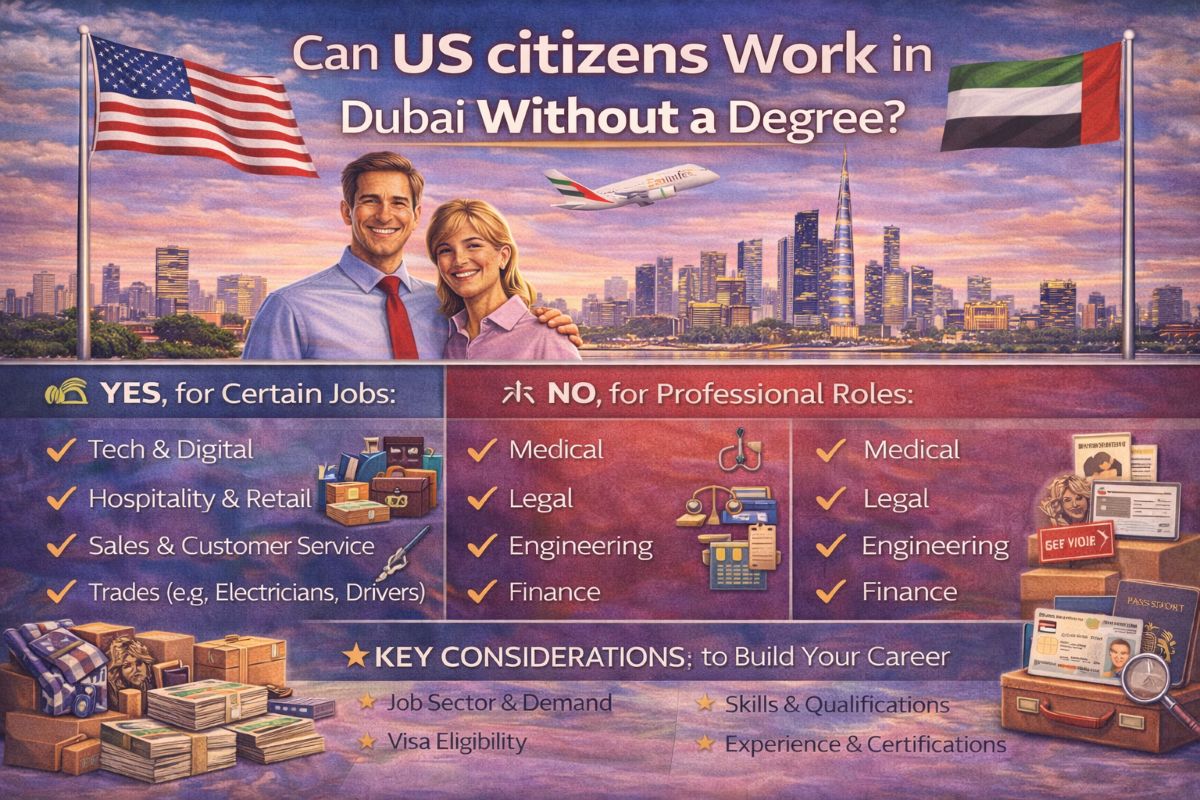
Can US Citizens Work in Dubai Without a Degree?
This question usually comes up later in the conversation, not at the beginning. At first, there is curiosity about Dubai, then a job listing, maybe a recruiter message, and only after that the real concern surfaces. Is a degree mandatory. Can experience replace formal education. Can US citizens work in Dubai without a degree in a way that is legal, stable, and worth the move. This guide approaches the topic the way we would discuss it face to face, slowly, honestly, and without shortcuts.
Why Americans ask if they can work in Dubai without a degree
In the United States, career paths have changed dramatically. Many Americans build strong professional lives without formal degrees. Sales leaders, operators, technicians, digital specialists, and managers often rely on experience rather than credentials. When Dubai enters the picture, the fear is that the system might be rigid or outdated.
Dubai is not a degree obsessed market, but it is a regulated one. That distinction matters. The city is built around international hiring, yet it operates within clearly defined legal frameworks. Americans exploring work in Dubai without a degree are usually trying to understand whether those frameworks allow flexibility or shut the door completely.
The short answer is that it depends on the role, the industry, and the employer. The longer answer is where clarity replaces anxiety. Understanding how Dubai evaluates eligibility is the first step toward making realistic decisions.
How employment eligibility works in Dubai for US citizens
All legal employment in Dubai is tied to employer sponsorship. There is no self sponsored standard work visa for employees. This means the employer plays a central role in determining whether a degree is required. The government evaluates the job classification, not personal ambition.
Nationality rarely blocks employment. Role classification does. Certain professions are regulated and require formal education by law. Others are open to experience based hiring as long as the employer can justify the role and meet compliance standards.
For US citizens, this system can feel unfamiliar. In practice, it creates clarity. You either fit the category or you do not. When you do, the process is straightforward. When you do not, no workaround will make it legal. This honesty, while sometimes uncomfortable, prevents long term risk.
Degree requirements in Dubai explained realistically
Some roles legally require a degree. Healthcare professionals, engineers in regulated roles, licensed teachers, and certain technical specialists fall into this category. No amount of experience replaces formal credentials here. The system is strict and non negotiable.
Other roles sit in a gray area. Corporate positions, mid level management, operations, and commercial roles may list degree requirements, but employers often prioritize experience. In these cases, the degree is preferred rather than mandatory.
Then there are roles where experience clearly outweighs education. Sales, business development, logistics, hospitality management, real estate support, digital marketing, and many operational roles fall into this category. In these fields, results, references, and track record often matter more than diplomas.
Can US citizens get a Dubai work visa without a degree
Yes, US citizens can obtain a Dubai work visa without a degree, but only if the role allows it. The visa itself does not demand education. The job classification does. If the position does not legally require a degree and the employer is willing to sponsor, the visa can be issued.
Employer discretion is critical. Some companies avoid non degree hires due to internal policy or risk tolerance. Others actively seek experience driven professionals and are comfortable justifying their choice. Company size, industry, and compliance culture all influence this decision.
This is why clarity matters early. Applying blindly wastes time. Targeting the right roles with the right employers changes outcomes dramatically.
Industries where Americans work in Dubai without a degree
Several industries regularly employ Americans without formal degrees. Sales roles are common, especially in B2B environments. Real estate support and brokerage related positions also attract experienced Americans, though licensing rules apply.
Hospitality and service management roles value leadership and operational experience. Logistics, operations, and supply chain functions often prioritize execution over credentials. Digital roles such as content creation, performance marketing, and creative services rely heavily on portfolios rather than diplomas.
What unites these roles is measurable output. Employers want proof that you can perform, not certificates that suggest you might.
The role of experience and professional background
Experience replaces education only when it is visible. Years alone do not matter. Results do. Americans who succeed in Dubai without degrees can usually demonstrate clear achievements, progression, and responsibility.
References carry weight. Employment letters, documented responsibilities, and proof of leadership help employers justify sponsorship. A strong narrative matters. Not exaggeration, but clarity.
Positioning is everything. When experience is framed correctly, the degree question often fades into the background. When it is vague, the door closes quickly.
Employer sponsorship and risk tolerance
Not all employers think the same way. Larger, highly regulated companies often prefer degree holders to reduce compliance risk. Smaller or more entrepreneurial firms may be flexible and value experience above all else.
Understanding this difference saves time. Applying to the wrong employer leads to rejection that feels personal but is purely structural. Aligning with companies whose hiring philosophy matches your profile creates momentum.
For Americans without degrees, patience and targeting matter more than volume.
Documentation requirements for non degree applicants
Without a degree, other documents take on greater importance. Employment letters detailing roles and responsibilities. Reference contacts. Portfolios or case studies where relevant.
These documents help employers defend their hiring decision during visa processing. Weak documentation creates hesitation. Strong documentation creates confidence.
Preparing this material before applying changes the tone of conversations immediately.
Salary expectations for Americans without a degree in Dubai
Salaries vary widely. Entry level roles pay modestly. Experienced professionals can earn competitive incomes. The gap is large and depends on value delivered rather than credentials.
Some Americans accept lower initial salaries to enter the market, then grow quickly. Others negotiate strong packages based on niche skills. There is no single path.
Understanding trade offs matters. Income, opportunity, and lifestyle must be evaluated together rather than in isolation.
Legal limitations and common misconceptions
Working on a visitor visa is illegal. This includes unpaid work, trial periods, and informal arrangements. Many Americans underestimate this risk based on online stories. Those stories rarely include the consequences.
Freelancing without proper licensing is also illegal. Short term work permits exist, but they are specific and limited. Assuming flexibility where none exists leads to serious problems.
Dubai rewards compliance. It punishes improvisation.
Career growth and long term prospects without a degree
Many Americans build long careers in Dubai without degrees. Skill accumulation matters more over time than initial credentials. Promotions, leadership roles, and business ownership become possible.
At some point, formal qualifications may become useful. Not mandatory, but helpful. Some choose to study later. Others focus on specialization. Both paths work.
What matters is momentum. Dubai respects consistency and performance.
Comparing Dubai and the US job market for non degree professionals
The US often emphasizes credentials for entry, then performance later. Dubai often flips that order. Performance opens doors first, credentials matter when regulation requires them.
This difference benefits experienced professionals who felt limited by formal education requirements back home. International experience also becomes leverage for future roles globally.
Dubai does not erase limitations, but it reshapes them.
Who working in Dubai without a degree works best for
This path suits Americans with strong experience, clear value, and realistic expectations. It works well for self directed professionals who communicate confidently and prepare thoroughly.
It is less suitable for those seeking shortcuts or informal arrangements. Dubai is structured. It rewards discipline more than improvisation.
Alignment determines success more than ambition.
Summary
US citizens can work in Dubai without a degree, but only within defined boundaries. Employer sponsorship, role classification, and documented experience decide outcomes. When approached honestly and strategically, Dubai offers real opportunities for experienced Americans without formal education. The key is clarity, patience, and respect for the system.