
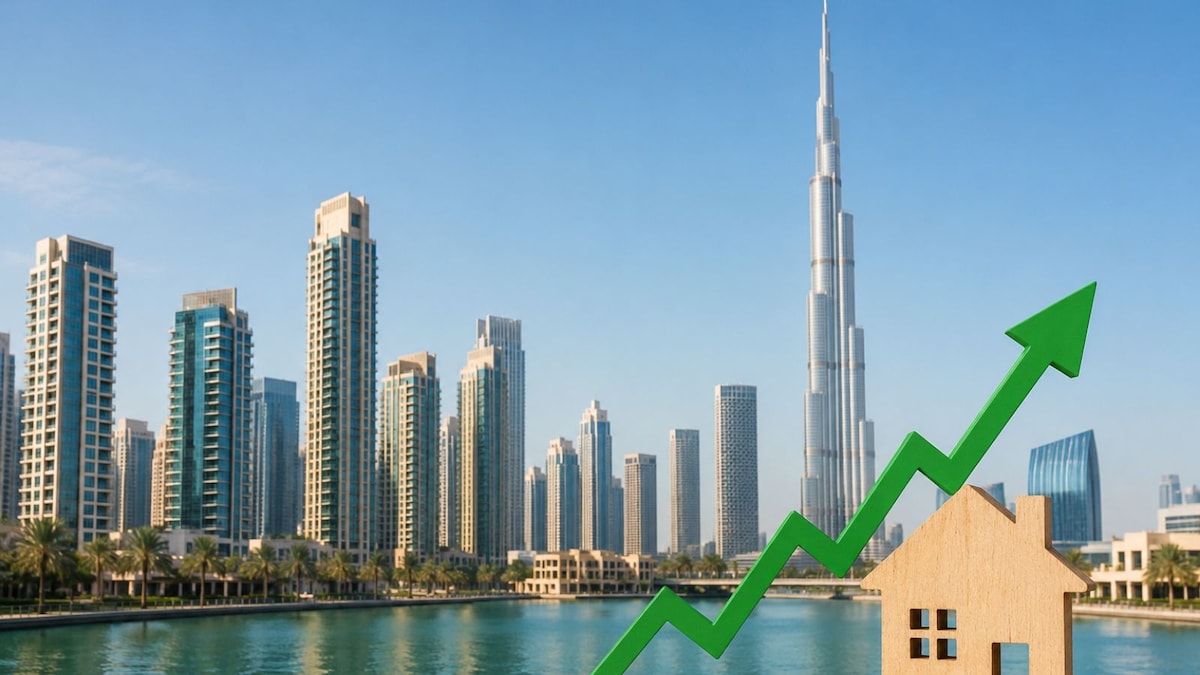
Dubai property sales defy expectations amid conflict; prices up 6% from last year.
Dubai’s residential property market has demonstrated notable resilience amid regional unrest, particularly during the Iran conflict earlier this year. Despite significant volatility in real estate stocks, home prices sustained their value, pointing to the robustness of the market’s foundational elements.
Market Trends: A Sharp Contrast
Reports from ANAROCK reveal a significant drop in Dubai real estate stocks, which plummeted by as much as 34% during the escalating tensions from February to April 2026. In stark contrast, residential property prices experienced only a modest decline of 4 to 7%. This disparity represents the most pronounced gap between market sentiment and actual asset performance observed during any crisis affecting Dubai in recent years. The average price of residential properties during the first half of 2026 reached approximately AED 1,900 (around ₹44,300) per square foot, reflecting a 6% increase from the AED 1,800 (around ₹42,000) recorded in the same period in the previous year.
Robust Sales Performance
In 2025, Dubai’s real estate market witnessed a remarkable surge, with over 206,166 residential transactions totaling AED 547 billion (approximately ₹12.7 lakh crore). This marked an impressive 18% increase in transaction volumes compared to the previous year, while the overall sales value rose nearly 26% year-on-year. To put this in perspective, the sales figures were ten times higher than the AED 54 billion (around ₹1.3 lakh crore) recorded in 2020. The first half of 2026 alone contributed AED 225.7 billion (around ₹5.3 lakh crore) in residential transactions, indicating the market’s sustained momentum.
Off-plan properties continued to dominate, constituting nearly 70-77% of all transactions during this period. This reflects a consistent preference among buyers for new developments, further bolstering the market’s stability.
Enduring Market Fundamentals
Aayush Puri, CEO of ANAROCK Channel Partners (India), remarked on the challenges posed by the conflict in early 2026. “This period tested Dubai’s residential market amidst peak regional uncertainty,” he noted. However, buyer activity rebounded steadily post-conflict, showcasing a resilient demand underpinned by strong market fundamentals rather than mere speculation. In the first half of 2026, residential transactions worth AED 225.7 billion demonstrated a 15% growth compared to 2024, albeit 16% lower than the standout figures of 2025.
ANAROCK anticipates residential prices in Dubai could rise by an additional 4-7% through 2026, with a potential upside of 8-13% if regional tensions subside. Nevertheless, the consultancy warns that renewed geopolitical conflicts in the latter half of the year could represent a significant risk to residential demand.
In summary, Dubai’s real estate sector has shown impressive resilience, maintaining strong performance indicators amid external challenges. While the market faces uncertainties, the fundamentals supporting recovery appear robust, making Dubai an attractive proposition for real estate investors despite the geopolitical landscape.