
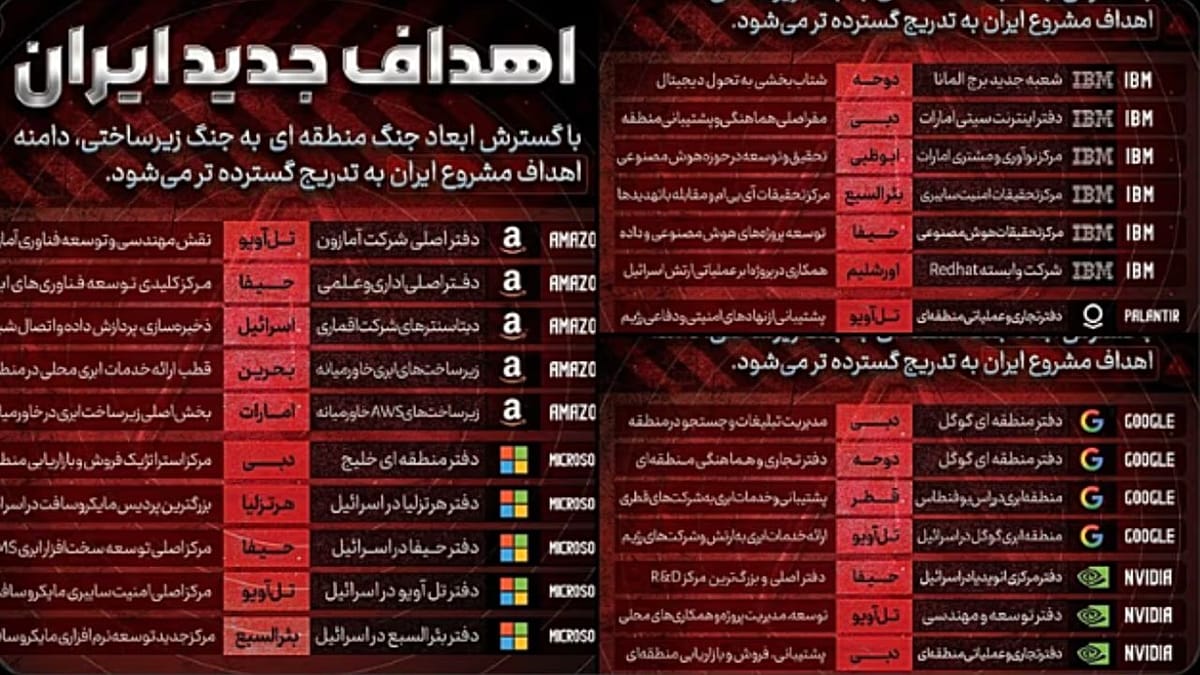
Iran Threatens to Target 17 U.S. Tech Firms by April 1
Iran’s Islamic Revolutionary Guard Corps (IRGC) has issued a stark warning to American technology firms, indicating that it will pursue them across the Middle East starting April 1. This threatening announcement highlights rising tensions between Iran and the United States, particularly within the tech sector, emphasizing the geopolitical implications of recent actions and decisions made by these companies.
Targeted American Companies
The IRGC’s declaration explicitly names 17 American corporations, which are now considered potential targets. This list includes major players like Cisco, HP, Intel, Oracle, Microsoft, Apple, Google, Meta, IBM, Dell, Palantir, Nvidia, J.P. Morgan Chase, Tesla, General Electric, Spire Solution, and Boeing. Additionally, Emirati firm G42 has also been flagged. According to the IRGC, these technology companies play a crucial role in facilitating U.S. actions perceived as hostile towards Iran, particularly concerning surveillance and drone strikes. An IRGC Telegram post declares, “We will target American technology companies for every assassination in Iran,” further underscoring the gravity of their intentions.
The IRGC claims that American tech firms are “the main element” in orchestrating operations viewed as terroristic by Iran. They emphasize that these companies ignored multiple warnings to cease their purported involvement in activities deemed harmful to Iranian interests. In a dire caution, the IRGC urged tech employees to vacate their workspaces immediately to ensure their safety.
Previous Warnings on Technology Infrastructure
This announcement arrives on the heels of a previous report from Tasnim, an Iranian news outlet connected to the IRGC, which identified 30 technological bases across the Middle East as potential targets. These locations were categorized as “enemy technology infrastructure.” Notable sites identified include tech hubs in Dubai, UAE, and Tel Aviv, Israel, particularly around the offices of defense technology firms like Palantir and major corporations such as Amazon and Microsoft.
The identified targets were primarily selected due to their involvement in artificial intelligence (AI) development and cloud computing services that, according to Iranian authorities, support military activities. Recently, two of Amazon’s data centers in the UAE faced attacks, purportedly designed to shed light on the role these centers play in bolstering the enemies’ military and intelligence capabilities.
Military Connections and Accountability
The IRGC has explicitly singled out offices of Oracle, IBM, and Google located in Jerusalem, Tel Aviv, and Abu Dhabi for their alleged provision of technological infrastructure to military entities. Compounding the situation, companies like Amazon and Google have faced scrutiny for receiving substantial contracts from the Israeli government. A UN report cited that these contracts included significant cloud and AI technology provisions aimed at furthering military objectives.
Furthermore, claims have been made that IBM has provided training to Israeli military personnel, while Palantir is believed to play a role in predictive policing for the Israeli government. More distressingly, Oracle executives have been reported as advocating for a cultural affinity towards Israel in the U.S., raising eyebrows regarding corporate ethics in geopolitical matters.
In an increasingly interconnected world, the intersection of technology and international relations is becoming fraught with consequences that extend beyond mere business. As tensions rise, companies involved may need to reassess their relationships and roles within volatile regions. The IRGC’s declarations serve as a stark reminder of the potential repercussions corporate decisions can have in the sphere of international conflict and security.